Personalized Longevity Care: What Medicine 3.0 Means

Personalized Longevity Care: What Medicine 3.0 Really Means
Medicine 3.0 is shifting healthcare from reactive disease management to proactive, personalized prevention. Dr. Jack Penner explains how advanced biomarkers, functional testing, and high-touch relationships help patients preserve strength, cognition, and metabolic health so they can age into the life they want, not just “avoid diagnosis.”
Medicine 1.0, 2.0, and 3.0 explained:
Medicine 1.0 focused on acute care and infectious disease, prioritizing survival through emergency intervention and short-term treatment.
Medicine 2.0 shifted toward chronic disease management, emphasizing diagnosis, medication, and risk reduction once conditions had already developed.
Medicine 3.0 emphasizes proactive prevention and personalized care, using longitudinal data, advanced diagnostics, and lifestyle optimization to preserve healthspan and delay disease before symptoms appear.
What is personalized longevity care in Medicine 3.0?
When I sat down with Dr. Jack Penner, it was obvious he wasn’t playing the same game as traditional medicine. Jack left a UCSF faculty position to build Kuros, a practice designed around personalized, proactive longevity care.
His background makes the pivot feel inevitable. He grew up watching his father do community primary care for 45 years. He also lived in the performance world as an athlete, strength coach, and public health student. As he put it, he’s seen both realities: the system that manages disease, and the system that builds capability, recovery, and vitality.
Medicine 3.0 sits at that intersection.
Jack’s definition of personalized longevity care is refreshingly grounded. It’s not about chasing a perfect lab panel or turning life into a spreadsheet. It starts with one strategic question:
“What life do you want to age into?”
Everything flows backward from that. Diagnostics, training priorities, nutrition, sleep, supplements, and medications only matter insofar as they support that goal. That is the unlock. Traditional care asks, “What’s wrong?” Medicine 3.0 asks, “Where are we going, and what will stop you if we don’t act early?”
Why is Medicine 3.0 replacing traditional primary care?
If you’ve interacted with the conventional system lately, you know the workflow: short visits, limited prevention, and a focus on managing problems once they show up.
Jack said it bluntly: traditional medicine keeps people functional. Personalized longevity care helps them stay exceptional.
Here’s what changes in Medicine 3.0.
Earlier detection and earlier action
Most primary care systems don’t escalate until markers cross official thresholds. In longevity care, trends matter earlier. A1c, fasting insulin, waist circumference, blood pressure, and fitness decline are treated as leading indicators, not trivia.
Better diagnostics, used strategically
Medicine 3.0 clinics tend to use advanced tools earlier because the big killers are predictable: cardiovascular disease, metabolic dysfunction, and neurodegeneration. So the testing menu often includes:
> ApoB and Lp(a)
> Advanced lipid fractionation
> Genomics when relevant (like ApoE context)
> Fitness, bone, and metabolic functional testing
These are not “luxuries” in Jack’s model. They are decision tools.
High-touch support instead of generic advice
Jack does not do the “diet and exercise” pep talk. He wants specifics because specifics create results.
Send the meals. Send the workouts. Send the sleep data. Then iterate.
Behavior change does not happen from a handout. It happens from relationship, troubleshooting, accountability, and a plan that fits the real constraints of someone’s life.
What tests matter most in Medicine 3.0 (and what they reveal)?
One of the cleanest ways to understand Medicine 3.0 is to look at what it measures and why.
Here’s the practical lens Jack uses:
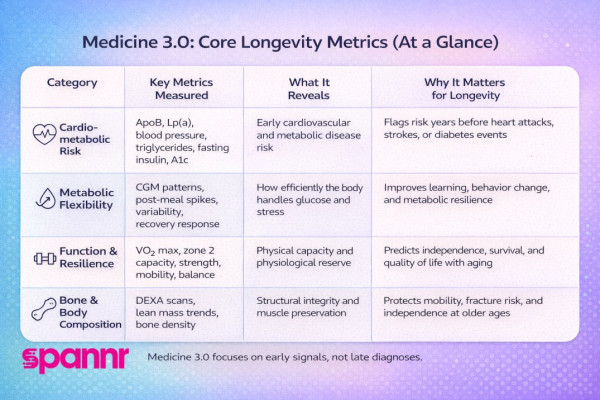
The key point is not to run everything all at once. The key is to run the right tests for the person, then turn that data into a prioritized plan.
How does personalized longevity care work day to day?
A recurring theme in my conversation with Jack was the danger of data without direction.
He recently wrote about the false promise of health information: companies selling huge panels with zero clinical strategy behind them. His point was simple: data does not create outcomes. Implementation does.
The value comes from a clinician who can:
> interpret signals accurately
> prioritize what matters now versus later
> manage trade-offs across systems
> translate plans into real behavior over years
Longevity is not siloed. Improving one metric can compromise another if you do it blindly. Better bone density is great, but not if it wrecks aerobic capacity. Better glucose is great, but not if lipids deteriorate due to the wrong lever. Medicine 3.0 is systems-thinking with a long time horizon.
And yes, accountability is part of the product. Not motivational fluff, real oversight.
If you’re training for something hard, like an endurance event or a major strength goal, you already understand this. You do not want more information. You want better decisions and consistent execution.
What does a Medicine 3.0 clinic do differently (and who is it for)?
Jack built Kuros for patients who want more than survival metrics. The practice is designed for people who:
> want to stay physically active as they age
> care about prevention more than quick fixes
> value partnership, dialogue, and accountability
> have performance goals, adventure goals, or identity goals
> want to prevent the big killers before they arrive
One of Jack’s best lines is this: people do not just want more years. They want more life in their years.
That means the model has to account for emotional health, purpose, stress load, community, and identity. Longevity without meaning is just prolonged time.
How do you start Medicine 3.0 in the next 30 days?
If you want a clean starting playbook, here it is:
Pick your North Star
What do you want to be able to do at 60, 70, 80?
Measure the right basics
Blood pressure, body composition, fasting insulin or A1c trends, lipids, sleep consistency, and a simple fitness benchmark.
Fix the obvious bottlenecks first
Sleep, protein, resistance training, and zone 2 are still the highest ROI stack for most people.
Add advanced testing only when it changes decisions
That is the Medicine 3.0 filter that keeps this from turning into expensive noise.
Key Takeaway
Personalized longevity care is not a luxury. It is a logical evolution of medicine. By focusing on earlier diagnostics, prevention, and long-term clinician partnership, Medicine 3.0 helps people preserve strength, cognition, metabolic health, and identity as they age.
If Medicine 2.0 is about surviving, Medicine 3.0 is about thriving.
In Closing (from Brent)
What I like about Jack is that he doesn’t sell a fantasy. He sells a system.
Medicine 3.0 is not about living forever. It’s about reducing preventable damage, staying capable, and building a plan you can actually follow for decades. That requires better tests, yes. But more importantly, it requires a real relationship with someone who can interpret the data, prioritize the levers, and keep you on track when life gets messy.
The future of healthcare isn’t more information.
It’s better decisions, made earlier, with accountability built in.
That’s what personalized longevity care is really offering.
FAQs about Personalized Longevity Care
Why was the banana smoothie issue such a big deal in 2025?
Because a controlled study reported banana blended with berries can dramatically reduce flavanol absorption. It shifted the conversation from “healthy foods” to “healthy combinations.”
Do post-meal walks really help glucose control?
Yes. Even 10 minutes right after eating can meaningfully reduce glucose spikes for many people, especially after carb-heavy meals.
Is timing more important than food choice?
Often, yes. Post-meal movement and food sequencing can outperform restriction alone because they’re easier to sustain.
What longevity gifts actually worked in 2025?
The winners were tools that create feedback loops: biological age testing, wearables, heat exposure routines, and simple interventions people used consistently.
What’s the biggest longevity lesson from 2025?
Small, repeatable behaviors consistently outperform expensive, inconsistent interventions.
Disclaimers
Medical Disclaimer:
This article is for educational purposes only and is not medical advice. Consult a qualified healthcare professional before making health decisions.
Affiliate Disclosure:
Spannr may receive compensation when you click partner links. As an Amazon Associate, we earn from qualifying purchases.
HIPAA/PHI Notice:
Do not send personal medical information via email or unsecured channels.
About the Author