2025 Longevity Wins: The Year the Science Caught Up
Was 2025 the Year Longevity Finally Went Mainstream?
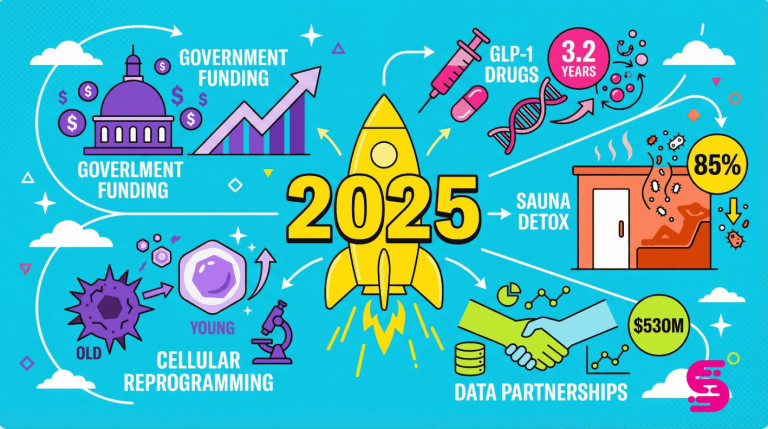
2025 marked a real turning point for longevity science. Governments began funding healthspan research, drugs influenced biological aging markers, heat exposure showed consistent cardiovascular benefits, and Big Pharma committed capital to the study of aging biology. Longevity is no longer theoretical. It’s measurable and increasingly actionable.
What Actually Changed in Longevity Science in 2025?
If you zoom out, 2025 wasn’t about a single miracle discovery. It was about validation.
For years, longevity lived at the edges of medicine. Researchers discussed aging as a biological process that could be modified, but funding, regulation, and mainstream healthcare largely ignored the idea. That changed this year.
Public and private institutions began treating aging not as an inevitability, but as a cost center and a solvable problem. The U.S. government expanded healthspan-focused research initiatives through ARPA-H, explicitly targeting the biological drivers of chronic disease and late-life decline. When governments start allocating resources, it signals that aging is no longer just philosophical. It’s economic.
At the same time, pharmaceutical and biotech companies stopped hedging. Capital flowed into epigenetic testing, longitudinal human datasets, and early-stage cellular rejuvenation platforms. Longevity crossed an important threshold: from fringe curiosity to strategic investment category.
Why 2025 Forced Aging Into the Mainstream Conversation
Two developments changed the tone of longevity discussions permanently.
First, biological age moved from theory into human data. GLP-1 medications, originally designed for diabetes and obesity, demonstrated consistent improvements in metabolic health and downstream aging biomarkers in human populations. Some early reports suggested favorable shifts in epigenetic age measures, partially independent of weight loss. While this area remains emerging, the implication is important: aging biology may be pharmacologically influenced in people, not just animals.
Second, environmental stressors became measurable. Long-term observational data continued to associate regular sauna exposure with lower cardiovascular mortality and improved vascular function. The mechanisms were not mysterious: heat shock protein activation, improved endothelial function, and autonomic nervous system regulation. While claims around “detoxifying microplastics” remain speculative, the cardiovascular and metabolic benefits held up under scrutiny.
Together, these findings reframed longevity from “optimize lifestyle” to “intervene at the systems level, then measure the response.”
How People Actually Capitalized on Longevity Wins in 2025
The smartest move in 2025 was not chasing new supplements. It was building feedback loops.
Three strategies consistently separated people seeing progress from those spinning their wheels:
1. Metabolic Visibility
Short-term use of continuous glucose monitors gave people real insight into how food, sleep, stress, and timing affected their physiology. Guesswork gave way to data, which changed behavior far more effectively than education alone.
2. Hormetic Stress, Applied Correctly
Heat exposure and cold exposure moved from novelty to foundation. Regular sauna sessions, paired with brief cold exposure, supported cardiovascular health, mitochondrial efficiency, and stress resilience. The key wasn’t intensity. It was consistency.
3. Longitudinal Health Tracking
Wearables, epigenetic age tests, and repeat blood panels allowed individuals to track trends instead of snapshots. This mirrored exactly what biotech companies are doing at scale: measuring change over time rather than reacting to one-off lab results.
The pattern was clear. The people benefiting most weren’t chasing trends. They were building systems.
What Comes After 2025’s Longevity Breakthroughs?
If 2025 was the year of validation, the next phase is translation.
Partial cellular reprogramming entered early human safety trials, marking the most difficult transition in medicine: moving from animal success to human application. These approaches aim to reset aspects of cellular age without erasing identity, potentially changing how degeneration is treated.
At the same time, pharmaceutical interest in longevity data confirmed a new reality: your health data has economic value. The future of medicine is predictive, preventative, and personalized, not reactive.
The important part is this: you don’t have to wait.
The same mechanisms under investigation in labs today, mitochondrial support, autophagy, senescent cell management, nervous system regulation, are already accessible through lifestyle, tracking, and targeted interventions.
Longevity is no longer locked behind research papers. It’s about execution.
A Note From Me
Looking back, 2025 wasn’t about proving immortality. It was about proving agency.
Aging is still real. Decline is not optional. But helplessness is.
The people who will benefit most from the next decade of longevity medicine won’t be the ones waiting for insurance coverage. They’ll be the ones who started tracking early, regulated stress, used heat and cold intelligently, and paid attention while others dismissed it as hype.
This was the year the excuses ran out.
Here’s to making 2026 even more interesting.
Cheers,
Brent
FAQs about Longevity
Did any longevity intervention actually reverse aging in 2025?
Human data showed favorable shifts in biological aging markers, particularly in metabolic interventions, but this remains an emerging area rather than settled clinical consensus.
Is longevity medicine only for the wealthy?
No. Many high-ROI interventions like sleep optimization, resistance training, walking, and heat exposure are accessible and affordable.
Are governments really funding aging research now?
Yes. U.S. federal initiatives now explicitly target healthspan and aging biology through advanced research programs.
Should everyone use GLP-1 drugs for longevity?
Not necessarily. These drugs show promise but lifestyle, muscle preservation, and metabolic health remain foundational.
What’s the most practical longevity step today?
Track your health consistently, apply simple repeatable interventions, and reassess using data instead of assumptions.
Disclaimers
Medical disclaimer:
Content is for educational purposes only and is not medical advice. Always consult a qualified healthcare professional before making changes to your health regimen.
Affiliate disclosure:
Spannr may receive compensation when you click partner links and make a purchase. As an Amazon Associate, we earn from qualifying purchases.
HIPAA / PHI notice:
Do not send personal medical information to this inbox. Spannr does not collect or store PHI via email.
About the Author