2025 Longevity Year in Review: What Actually Worked
2025 Longevity Year in Review: What Actually Worked
2025 exposed how small habits quietly overpower expensive routines. Bananas undercut berry benefits in smoothies, short post-meal walks blunted glucose spikes, and the best longevity gifts were the ones that changed biomarkers, not vibes.
What were the biggest longevity lessons of 2025?
Every year, longevity gets louder and more confusing.
In 2025 we got more supplements, more devices, more influencers, and more “breakthroughs” than ever. But when you zoom out and ask what actually moved health markers, the winners were not flashy.
They were repeatable.
At Spannr, the same themes kept resurfacing all year: “healthy” habits that quietly cancel themselves out, and simple interventions outperforming expensive protocols because they are easier to do consistently.
Three ideas defined the year:
> Food combinations matter more than most people realize
> What you do after eating can matter more than what you ate
> The best tools are the ones that change decisions through feedback
Do bananas reduce berry polyphenol benefits in smoothies?
Let’s talk about the banana.
Early in 2025, research began circulating more widely showing bananas contain polyphenol oxidase (PPO), an enzyme that can degrade certain polyphenols, including flavanols. Those flavanols are a big reason berries show up in longevity diets in the first place.
Banana + berries = not ideal if your goal is flavanols
By mid-year, the headline became unavoidable: a controlled human study reported that adding banana to a berry smoothie reduced flavanol absorption by up to 84%.
That finding changed the framing. Longevity is not just “good foods vs bad foods.” It’s biology. It’s interactions. It’s outcomes.
Bananas are not the villain. The combination is the problem when your goal is maximizing berry-derived flavanols.
What to use instead of bananas in smoothies
If you want sweetness and texture without potentially undermining the berry goal, try these swaps:
> For sweetness: mango, pineapple, or a small amount of dates
> For creaminess: Greek yogurt, kefir, cottage cheese, or protein powder
> For thickness: oats, chia, flax, or avocado
> For the “still feels like a treat” factor: cinnamon, cocoa, vanilla, or nut butter
Simple rule: keep bananas in your life. Just do not make them the berries’ roommate in the blender.
Do post-meal walks reduce glucose spikes?
The most effective glucose hack of 2025 did not come in a bottle.
It came in shoes.
The reason is straightforward: moving your muscles after a meal increases glucose uptake, which can reduce the size and duration of post-meal glucose excursions. In practice, it became one of the simplest ways to make carbs less metabolically expensive.
And 2025 made one part crystal clear: timing matters. Doing it right after eating is the point. Waiting too long usually blunts the effect.
By the holidays, this became our favorite rule of thumb: eat the pizza, skip the guilt, go for the walk.
Not discipline. Timing.
The 10-minute post-meal walk protocol
If you want the version that actually gets done:
> Walk for 10 minutes after your largest meal
> Start immediately or within 15 minutes
> Keep it easy pace (you should be able to talk)
> Use it strategically after carb-heavy meals, travel days, and holidays
> If you cannot walk: do light stairs, easy cycling, or household movement for 10 minutes
This is not about punishment cardio. It’s about sequencing.
What are the best longevity gifts of 2025 for biomarkers?
Every year has a wellness aesthetic. 2025 was no different.
But when we looked at what people actually used and what moved measurable markers, the pattern was obvious. The best longevity gifts shared three traits:
Feedback: they show you something real
Consistency: you will actually use them
Biological relevance: they influence meaningful outcomes
Here are the gifts that consistently earned their keep.
Longevity gifts that actually mattered in 2025
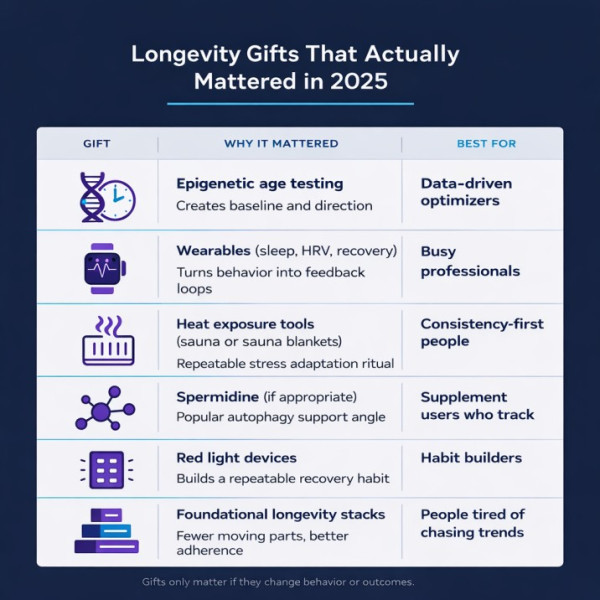
Big idea: gifts only matter if they change behavior or outcomes. If it does not create feedback, it’s mostly decoration.
How to apply the 2025 longevity lessons in 2026
If 2025 proved anything, it’s this: longevity is not about stacking more interventions. It’s about removing friction and executing the basics consistently.
Here’s the 2026 playbook:
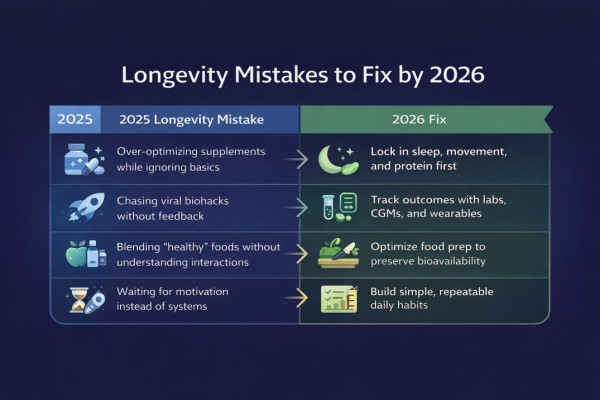
> Fix the smoothie mistake
> Walk after meals that matter
> Choose tools that report back with real feedback
> Pick fewer habits and repeat them longer than you think you need to
> Track outcomes, not vibes
From where I sit, the biggest gains did not come from exotic therapies. They came from people understanding how small behaviors compound biologically.
That’s not a trend. That’s a reset.
Key Takeaway
2025’s biggest longevity win wasn’t a new supplement. It was fewer unforced errors and more repeatable habits: smarter food combinations, post-meal movement, and tools that created measurable feedback.
In Closing (from Brent)
What I loved about 2025 is that it forced a reality check.
The banana smoothie story was humbling because it showed how easy it is to do a “healthy thing” in a biologically inefficient way. The pizza walk was empowering because it showed you can live like a normal person and still blunt a major downside, if you nail the timing.
Going into 2026, I’m keeping it simple: fewer inputs, better sequencing, and tools that keep me honest.
And yes, for the record, put the banana down. Just not forever. Just not in that smoothie.
— Brent
FAQs about Longevity
Why was the banana smoothie issue such a big deal in 2025?
Because a controlled study reported banana blended with berries can dramatically reduce flavanol absorption. It shifted the conversation from “healthy foods” to “healthy combinations.”
Do post-meal walks really help glucose control?
Yes. Even 10 minutes right after eating can meaningfully reduce glucose spikes for many people, especially after carb-heavy meals.
Is timing more important than food choice?
Often, yes. Post-meal movement and food sequencing can outperform restriction alone because they’re easier to sustain.
What longevity gifts actually worked in 2025?
The winners were tools that create feedback loops: biological age testing, wearables, heat exposure routines, and simple interventions people used consistently.
What’s the biggest longevity lesson from 2025?
Small, repeatable behaviors consistently outperform expensive, inconsistent interventions.
Disclaimers
Medical disclaimer:
Content is for educational purposes only and is not medical advice. Always consult a qualified healthcare professional before making changes to your health regimen.
Affiliate disclosure:
Spannr may receive compensation when you click partner links and make a purchase. As an Amazon Associate, we earn from qualifying purchases.
HIPAA/PHI notice:
Do not send personal medical information to this inbox. Spannr does not collect or store PHI via email.
About the Author