Longevity Coach: What They Do, Cost & How to Find One (2026)

By Brent | Last Updated: September 8th, 2026
Longevity Coach: Who Are They and What Do They Do? (2026 Refresh)
The idea of wellness has matured. It's no longer just about workouts and macros. It's about how you age, how long you stay functional, and how well your systems hold up over decades.
That shift is exactly where longevity coaches come in.
A longevity coach isn't a miracle worker or a substitute for medical care. They sit in the middle ground between knowing what to do and actually doing it consistently enough for it to matter.
Key Takeaways
- A longevity coach helps you improve healthspan through sustainable lifestyle behaviors.
- Research shows health coaching improves behavior change, adherence, and clinical outcomes.
- Longevity coaches differ from health coaches by focusing specifically on long-term aging trajectories.
- There is no universal certification; evaluate coaches by their evidence-based approach and scope awareness.
- Costs range from hundreds to thousands of dollars, depending on the format and level of personalization.
- The best coach is one you'll actually engage with consistently.
What Is a Longevity Coach?
At the simplest level, a longevity coach helps you improve healthspan. Not just how long you live, but how well you live as you age.
Longevity is shaped largely by lifestyle behaviors. Physical activity, nutrition, sleep, stress, and social connection all strongly influence lifespan and healthspan (National Institute on Aging). Preventive, lifestyle-based approaches reduce the risk of chronic disease and premature mortality (CDC).
A longevity coach focuses on helping people apply those behaviors in a structured, personalized, and sustainable way.
They don't diagnose disease. They don't prescribe medication. Their value is in translating evidence-based guidance into daily action.
Quick Answer: A longevity coach helps clients improve healthspan by supporting sustainable lifestyle behaviors that influence aging—including movement, nutrition, sleep, stress management, and consistency. They differ from health coaches by focusing specifically on long-term aging trajectories rather than short-term wellness goals. Research shows health coaching improves behavior change and adherence. Costs range from hundreds to thousands of dollars. Look for coaches with evidence-based approaches who stay within their professional scope.
What Does a Longevity Coach Actually Do?
Longevity coaching is less about information and more about execution.
Most people already know the basics. Move more. Eat better. Sleep enough. The gap is adherence.
Research shows that health coaching improves behavior change and clinical outcomes. Coaching interventions also improve adherence and accountability over time.
Core Functions of a Longevity Coach
| Function | What It Looks Like | Why It Matters |
| Goal Clarification | Defining long-term health and aging goals | Creates direction and motivation |
| Lifestyle Assessment | Evaluating current patterns, habits, and health markers | Identifies gaps and opportunities |
| Plan Creation | Building realistic, personalized protocols | Ensures sustainability |
| Accountability | Regular check-ins, progress tracking | Closes the knowing-doing gap |
| Course Correction | Adjusting plans based on results and life changes | Maintains momentum |
Some coaches incorporate data like wearable metrics or biological age testing, but those tools support behavior change. They don't replace it.
Longevity Coach vs. Health Coach vs. Personal Trainer
The overlap can be confusing.
| Professional | Primary Focus | Scope | Typical Outcomes |
| Personal Trainer | Exercise performance, physical conditioning | Fitness-focused | Strength, endurance, body composition |
| Health Coach | General wellness habits (nutrition, stress, sleep) | Broad wellness | Short-to-medium term behavior change |
| Longevity Coach | Long-term aging trajectories, healthspan optimization | Comprehensive, long-term | Sustained habits, biological age, disease prevention |
| Longevity Doctor | Medical diagnosis, treatment, prescriptions | Clinical care | Disease management, lab optimization |
A personal trainer focuses primarily on exercise performance and physical conditioning.
A health coach usually works on general wellness habits like nutrition, stress, and sleep.
A longevity coach zooms out. They look at how all of those inputs interact over time and how they influence aging trajectories.
There's no strict licensing distinction. The difference is scope and framing. Longevity coaching prioritizes long-term resilience over short-term optimization.
For medical guidance, work with a longevity-focused physician or explore longevity clinics that integrate coaching with clinical care.
What Certifications Do Longevity Coaches Have?
There is no single governing body or universally recognized certification for longevity coaching.
That's important to understand upfront.
Many longevity coaches come from adjacent fields like health coaching, fitness, nutrition, or functional medicine support. Some pursue longevity-specific training programs, often as continuing education rather than formal licensure.
Others hold credentials from broader health coaching institutions or have backgrounds in exercise science or wellness education.
What Matters More Than Credentials
| Quality to Look For | Why It Matters |
| Evidence-based approach | Relies on research, not fads |
| Scope awareness | Knows when to refer to medical professionals |
| Collaborative mindset | Works with your healthcare team |
| Behavior change focus | Prioritizes sustainable habits over biohacking theatrics |
| Transparent about training | Clear about their background and limitations |
Longevity coaching is still an emerging field. Due diligence matters.
Who Should Consider a Longevity Coach?
Not everyone needs one.
People often seek a longevity coach when they feel stuck. They're doing "the right things" but not seeing progress, or they're unsure where to focus as they age.
Common Reasons to Seek Coaching
- Persistent low energy or poor sleep despite addressing basics
- Weight gain that doesn't respond to usual efforts
- Frequent minor health issues with no clear cause
- Difficulty staying consistent with healthy habits
- Desire to be proactive about aging rather than reactive
- Overwhelm from conflicting health information
- Major life transition (retirement, health scare, milestone birthday)
Some clients are already healthy and want a clearer long-term strategy. Others are trying to prevent decline before it starts.
Both are valid use cases.
For a more comprehensive medical assessment alongside coaching, consider longevity clinics that offer integrated programs.
What Is It Like Working with a Longevity Coach?
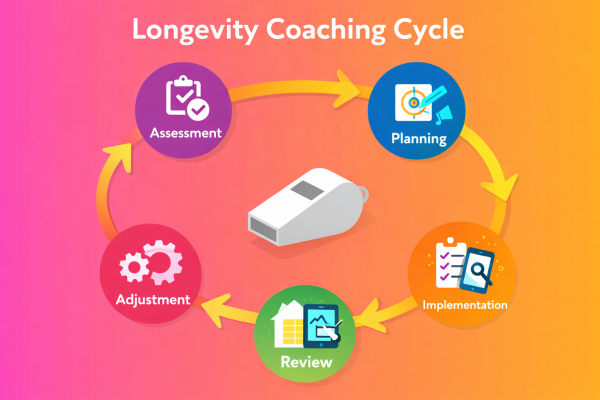
While approaches vary, most coaching relationships follow a similar structure.
Phase 1: Intake and Assessment
The coach gathers information about lifestyle habits, stress, sleep, movement, nutrition, and goals. Some incorporate biomarkers or biological age estimates, which are used to inform strategy, not define identity (PubMed).
Common assessment areas:
- Sleep patterns and quality
- Exercise habits and capacity
- Nutrition and eating patterns
- Stress levels and management
- Social connection and community
- Current health markers and testing
- Personal goals and values
Phase 2: Plan Creation
Together, you build a plan that fits your life. This is where personalization matters. Research shows that personalized lifestyle interventions improve cardiometabolic and health markers.
A good plan addresses:
- Priority areas for improvement
- Specific, measurable actions
- Timeline and milestones
- Potential obstacles and strategies
- Integration with medical care if needed
Phase 3: Ongoing Support
Progress is tracked. Adjustments are made. Accountability stays consistent. This is the part most people can't replicate on their own.
The goal isn't perfection. It's durability.
How Much Does a Longevity Coach Cost?
Costs vary widely.
| Format | Typical Cost Range | Best For |
| Digital/app-based | $50-200/month | Self-directed learners, budget-conscious |
| Group programs | $200-500/month | Community-oriented, moderate budget |
| Hybrid (digital + calls) | $300-800/month | Balance of support and affordability |
| One-on-one coaching | $500-2,000+/month | High-touch, personalized guidance |
| Intensive programs | $3,000-10,000+ (package) | Comprehensive transformation |
More individualized attention generally costs more. That doesn't automatically mean it's better. The best option is the one you'll actually engage with long enough to see change.
Some longevity clinics include coaching as part of comprehensive programs, which may be more cost-effective than separate services.
How to Find a Qualified Longevity Coach
Since there's no universal certification, choosing a longevity coach requires discernment.
What to Look For
| Green Flags | Red Flags |
| Transparent about background and training | Vague or inflated credentials |
| Avoids medical claims outside their scope | Makes diagnostic or prescriptive claims |
| Emphasizes lifestyle fundamentals | Promotes shortcuts or "biohacks" as primary strategy |
| Encourages collaboration with physicians | Discourages medical involvement |
| Focuses on consistency, not extreme protocols | Pushes aggressive, unsustainable approaches |
| Clear about what coaching can and can't do | Overpromises results |
Questions to Ask Before Hiring
- What is your training and background?
- How do you stay current on longevity research?
- What does a typical coaching relationship look like?
- How do you measure progress?
- How do you handle situations outside your scope?
- Can you work alongside my physician?
A good longevity coach should make health feel more manageable, not more complicated.
Longevity Coaching vs. Longevity Medicine
Coaching and medicine serve different but complementary roles.
| Aspect | Longevity Coach | Longevity Doctor |
| Focus | Behavior change, lifestyle optimization | Medical assessment, diagnosis, treatment |
| Tools | Accountability, planning, habit formation | Lab testing, prescriptions, procedures |
| Scope | Non-medical wellness support | Clinical care |
| Best for | Execution, consistency, lifestyle integration | Medical issues, advanced testing, and interventions |
Many people benefit from both. A longevity physician can order advanced testing like blood panels, epigenetic age tests, or preventative MRI scans, while a coach helps implement the lifestyle changes those results suggest.
Some longevity clinics integrate both services under one roof.
DIY Longevity: When You Might Not Need a Coach
Not everyone needs external coaching. You might be fine on your own if you:
- Have strong self-accountability
- Already maintain consistent healthy habits
- Understand the core longevity fundamentals
- Can interpret and act on health data independently
- Have a supportive community that reinforces good habits
Resources for self-directed learners:
- Guide to Longevity - comprehensive framework
- Longevity Books - deeper reading
- Longevity Podcasts - ongoing education
- Biological Age Testing - objective measurement
However, if you've tried going solo and struggle with consistency, a coach may provide the structure you need.
Finding Longevity Support Near You
Whether you want coaching, medical care, or both:
Longevity Doctors: Physicians specializing in preventive, longevity-focused care
Longevity Clinics: Comprehensive facilities offering testing, coaching, and treatment
City-specific guides: Find practitioners in Austin, Miami, Los Angeles, Chicago, San Francisco, Boston, Seattle, Las Vegas, and more
Longevity Retreats: Immersive programs combining education, treatment, and coaching
Browse our marketplace to find clinics and providers in your area.
Frequently Asked Questions
What is a longevity coach?
A longevity coach helps clients improve healthspan by supporting sustainable lifestyle behaviors that influence aging—including movement, nutrition, sleep, stress management, and consistency.
How much does a longevity coach cost?
Costs range from $50-200/month for digital programs to $500-2,000+/month for one-on-one coaching, depending on format and personalization level.
What is the difference between a longevity coach and a health coach?
Longevity coaches focus specifically on long-term aging trajectories and healthspan, while health coaches often focus on general wellness or short-to-medium term goals.
Do I need a longevity coach?
Not necessarily. Longevity coaching is most useful if you struggle with consistency, feel stuck despite good habits, or want structured accountability around aging well.
How do I find a longevity coach near me?
Many longevity coaches work remotely. Look for practitioners with relevant training, clear boundaries, and an evidence-based approach. Some longevity clinics include coaching in their programs.
What's the difference between a longevity coach and a longevity doctor?
A longevity doctor provides medical care, including diagnosis, testing, and prescriptions. A longevity coach focuses on behavior change and lifestyle implementation. Many people benefit from both.
Is longevity coaching worth the money?
If you struggle with consistency and the coach helps you maintain habits that improve health markers, it can be worth the investment. The key is choosing a coach you'll actually engage with.
What should I ask before hiring a longevity coach?
Ask about their training, how they measure progress, how they handle situations outside their scope, and whether they can collaborate with your physician.
Can a longevity coach help me lose weight?
Weight management may be part of a longevity coaching program, but it's typically approached through sustainable lifestyle change rather than short-term dieting. If you have medical weight concerns, work with a physician.
How long does longevity coaching typically last?
Engagement periods vary from a few months to ongoing relationships. Meaningful behavior change typically requires at least 3-6 months of consistent work.
About the Author