Cold Therapy for Longevity: What the Research Actually Shows
By Brent | Last Updated: March 3rd, 2026
Cold Therapy for Longevity: What the Research Actually Shows
Cold exposure sits in a weird spot. It's miserable on contact, then somehow you feel sharper, calmer, and more alive five minutes later.
That emotional whiplash is part of why cold plunges exploded. The other reason is simple: cold is a real biological stressor, and your body adapts to stress.
That idea is old. Our ancestors didn't live in climate-controlled bubbles. Temperature swings were normal. Modern life flattened that curve. Comfort went up. Environmental stress went down.
Some researchers argue that when cells are never challenged, they get fragile. Mild stressors like exercise and fasting teach the body to respond better. Cold can play in that same sandbox if you use it intelligently.
This isn't a "become an ice monk" pitch. It's a practical look at what cold therapy can do, where the evidence is strong, and where the hype needs to chill.
Key Takeaways
> Cold exposure triggers measurable changes in stress hormones, neurotransmitters, and brown fat activity.
> The strongest longevity case is risk-factor improvement through metabolic effects and stress resilience.
> There is no direct proof that cold therapy extends human lifespan, claims should stay healthspan-focused.
> Cold water immersion provides the strongest stimulus; cold showers are more accessible but less consistent.
> Progression and safety matter more than extreme protocols.
The Cold Plunge Craze: Hype vs. Reality
Cold therapy gets marketed like a miracle lever. Better mood, better metabolism, better recovery, better longevity.
Reality is more nuanced.
Cold exposure clearly changes stress hormones and neurotransmitters, increases brown fat activity in many people, and can reduce soreness after intense exercise. Those are measurable outcomes.
What it does not prove, yet, is that cold plunging directly extends human lifespan. The stronger story is that cold supports risk-factor improvement through metabolic effects, inflammation modulation, and stress resilience. That can matter for healthspan.
That's still a win. Just a more honest one.
Quick Answer: Cold therapy improves metabolic health, mood, and recovery through hormetic stress responses. Research shows cold exposure increases norepinephrine 2-3x, activates brown fat, and may improve insulin sensitivity. There's no direct proof of lifespan extension, but risk-factor improvements support healthspan. Start with short exposures you can control and repeat consistently.
How Cold Affects Your Body
When you hit cold water, your body reacts fast:
> Blood vessels constrict in the skin
> Heart rate and breathing spike
> Stress hormones rise
> You generate heat through shivering and non-shivering thermogenesis
That acute stress response is a feature, not a bug, if the dose is controlled. A 2018 review in Frontiers in Physiology describes cold stress as a hormetic stimulus that can trigger adaptive cellular changes over time.
The keyword is "adaptive." The goal isn't suffering. It's training your physiology.
This is the same hormetic principle that makes heat therapy, HIIT, and caloric restriction effective: controlled stress that triggers beneficial adaptation.
Mood, Dopamine, and the "Cold Reset" Feeling
People often describe cold exposure as mood-lifting. There's science behind that.
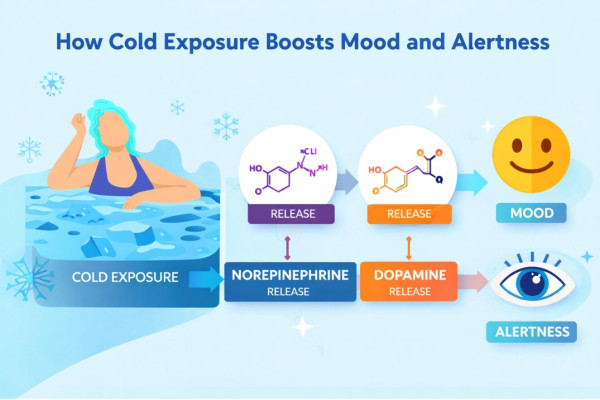
A 2016 paper in the International Journal of Neuropsychopharmacology links cold exposure with increased dopamine signaling and improved subjective mood measures.
Cold also increases norepinephrine, which is tied to alertness and attention. A 2001 study found cold exposure can raise plasma norepinephrine levels substantially, often in the 2–3× range.
That combination helps explain why people feel "switched on" afterward.
For those managing stress and its effects on aging, cold exposure offers a practical intervention that can reset baseline mood and alertness. It's not a replacement for addressing chronic stressors, but it can be a useful daily tool.
Brown Fat Activation and Metabolism
Cold exposure is one of the most reliable natural triggers of brown adipose tissue activity.
Brown fat is metabolically active tissue that burns fuel to generate heat. A 2012 study showed that cold exposure can acutely activate brown adipose tissue and increase energy expenditure.
Brown fat also has meaningful glucose uptake, which may support metabolic health. A 2017 review in PubMed Central discusses how activated brown fat increases glucose uptake and may contribute to improved insulin sensitivity.
This is one of cold therapy's strongest longevity-adjacent angles. Metabolic health is a big driver of aging outcomes. For those tracking metabolic markers, blood panel testing can show whether cold therapy is moving the needle on glucose regulation and metabolic function.
Non-Shivering Thermogenesis: The "Quiet Burn"
You don't need to shake like a cartoon character to get a metabolic effect.
Non-shivering thermogenesis increases metabolic heat production in response to cold, especially as brown fat and sympathetic signaling ramp up. A 2004 study details how cold exposure increases metabolic rate through non-shivering thermogenesis.
Some people will shiver early. Some won't. Both can be normal.
The target isn't heroic suffering. It's a clear stimulus your body has to respond to.
This metabolic adaptation is one reason cold exposure may support mitochondrial function over time, cells that regularly face thermal challenges may maintain better energy production capacity.
Immune Signaling: What Cold Might Do and What It Probably Doesn't
Cold exposure is often framed as "immune boosting." The evidence is more modest.
A 2010 study found that acute cold exposure can increase circulating leukocytes, suggesting a transient immune activation response.
That does not automatically translate into fewer infections or long-term immune improvement. Think of it as a short-lived stress response that may be part of a broader resilience pattern, similar to how exercise affects immune function.
Recovery and Performance: Where Cold Helps
Cold water immersion is commonly used for recovery, especially in endurance sports and high-volume training blocks.
A 2014 study found that cold water immersion can reduce delayed onset muscle soreness after intensive exercise.
That's a real benefit if soreness limits your ability to train consistently.
Timing caveat: If your goal is muscle growth or strength adaptation, timing may matter. The research on cold exposure immediately after resistance training is mixed and protocol-dependent. Some evidence suggests it may blunt the hypertrophy response. This is a good place to personalize based on your training goals rather than copying a one-size template.
Practical approach:
> Cold after endurance training: Generally helpful
> Cold after strength training: Wait 3-4 hours or use on rest days
> Cold for general recovery: Morning or evening, separate from training
Cold Plunge vs. Cold Shower vs. Cryotherapy
These methods aren't equal.
|
Method |
Temperature |
Duration |
Stimulus Strength |
Research Base |
Best For |
|
Cold Plunge |
40-60°F |
2-10 min |
Strongest |
Strong |
Metabolic, mood, recovery |
|
Cold Shower |
Variable |
1-5 min |
Moderate |
Limited |
Habit formation, accessibility |
|
Cryotherapy |
-200 to -300°F air |
2-3 min |
Variable |
Limited |
Convenience, novelty |
Cold plunge (full-body immersion):
> Strongest stimulus
> Most consistent temperature exposure
> Most studied in cold-water research contexts
Cold shower:
> Easier access
> More variable stimulus
> Still useful for mood and resilience, but harder to standardize
Cryotherapy:
> Very cold air exposure
> Short duration
> Less direct evidence compared to water immersion for many of the metabolic and signaling effects discussed above
If you want the highest signal per minute, immersion is usually the move. Browse our cold plunge marketplace for home and facility options.
If you want consistency and habit formation, showers can be enough.
Contrast Therapy: Combining Cold and Heat
Cold therapy pairs well with heat therapy in what's called contrast therapy.
The alternation between hot and cold creates a compounded hormetic stress that may amplify the benefits of each modality. Traditional practices like Russian banya have used this approach for centuries.
A typical contrast protocol might include:
> Sauna or hot tub: 10-15 minutes
> Cold plunge: 1-3 minutes
> Repeat 2-4 cycles
> End on cold for alertness, warm for relaxation
Both modalities are valuable independently, but the combination may offer unique vascular and resilience benefits that neither provides alone.
How Cold Is Cold Enough?
You want cold enough that your body registers a stress response, but not so cold that you're flirting with cold shock.
Cold shock is real. Water temperature and individual tolerance matter.
A practical approach is to start with "uncomfortable but controllable." You should be able to maintain slow breathing within the first minute. If you can't, the stimulus is too aggressive for your current level.
Progressive approach:
|
Week |
Temperature |
Duration |
Frequency |
|
1-2 |
60-65°F |
1-2 min |
2-3x weekly |
|
3-4 |
55-60°F |
2-3 min |
3x weekly |
|
5-6 |
50-55°F |
3-5 min |
3-4x weekly |
|
7+ |
45-55°F |
3-10 min |
3-5x weekly |
You can increase stimulus over time by:
> Gradually reducing temperature
> Gradually increasing exposure duration
> Increasing frequency
Progression beats bravado.
Safety Considerations
Cold exposure is a powerful stressor. Treat it like one.
Get medical clearance first if you have:
> Cardiovascular disease
> Arrhythmias
> Uncontrolled hypertension
> History of fainting
> Raynaud's disease
Consider consulting a longevity-focused physician if you're unsure about your baseline tolerance.
Safety rules:
> Avoid doing cold exposure alone if you're new to it
> Get out if you feel numbness spreading, confusion, chest pain, or loss of coordination
> Never force through warning signs
> Warm up naturally with movement afterward, not a hot shower immediately
Cold therapy should make you more resilient. Not make you a cautionary tale.
A Simple Way to Start
If you want a clean starting point:
> Start with short exposures a few times per week
> Focus on slow nasal breathing; this is the skill to develop
> Get out while you still feel in control
> Warm up naturally with movement afterward
> Track how you feel, mood, energy, sleep quality
Your goal is repeatability.
Cold therapy works best as a habit you can sustain, not a dare you survive once.
Cold Therapy and Sleep
Some people find cold exposure in the morning improves alertness and daytime energy, which supports better sleep at night through improved circadian rhythm regulation.
Others use evening cold exposure followed by natural warming to promote relaxation. The mechanism is similar to how heat therapy affects sleep; the subsequent drop in core temperature signals the body to prepare for rest.
Experiment with timing to find what works for your physiology. Morning cold tends to be more activating; evening cold (if brief) can still support relaxation if followed by adequate warming time.
Finding Cold Therapy Near You
Cold therapy options are increasingly accessible:
> Home cold plunges: Browse our cold plunge marketplace
> Gym and wellness centers: Many now offer cold plunge access
> Longevity clinics: Often include cold therapy in protocols
> Cryotherapy facilities: Available in most major cities
> DIY approaches: Cold showers, ice baths, outdoor swimming (with safety precautions)
For structured protocols and guidance, many longevity retreats now incorporate cold therapy as a core component.
Frequently Asked Questions
Does cold therapy extend lifespan?
There's no direct proof that cold therapy extends human lifespan. The stronger case is that cold can improve risk factors tied to aging, especially metabolic health and stress resilience, which may support healthspan.
How cold does the water need to be for health benefits?
Cold enough to trigger a clear stress response but safe enough that you can control your breathing and remain steady. Most research uses water in the 50-59°F range. Extreme cold isn't required and can be dangerous.
How long should I stay in a cold plunge?
Start short (1-2 minutes) and build gradually. The right duration is the one you can repeat consistently without excessive after-drop or prolonged discomfort. Many people build for 3-10 minutes over weeks.
Is cold therapy better than heat therapy for longevity?
They act through different pathways and can complement each other. Heat therapy has stronger cardiovascular and observational longevity data, while cold has stronger evidence around brown fat activation, catecholamines, and recovery effects. Contrast therapy combines both.
What are cold shock proteins?
Cold exposure can trigger cellular stress responses. Specific "cold shock protein" claims vary by context, and the strongest supported frame is hormesis and adaptation rather than any single magic molecule.
Can cold exposure help with weight loss?
Cold can increase energy expenditure and activate brown fat, which may support metabolic health. It's not a standalone fat-loss solution, but it can be a useful accessory to training, sleep, and nutrition.
Can I do cold therapy every day?
Yes, if you tolerate it well. Many practitioners build to daily cold exposure. Listen to your body, if you feel depleted rather than energized, reduce frequency.
Should I do cold therapy before or after a workout?
After endurance training: generally helpful. After strength training: wait 3-4 hours or use on rest days. Morning cold (separate from training) works well for mood and alertness.
How does cold therapy compare to exercise for longevity?
Cold therapy complements exercise but doesn't replace it. Exercise has much stronger direct evidence for lifespan extension. Cold adds metabolic and resilience benefits alongside a strong training program.
Cold exposure increases plasma norepinephrine 2–3× (PubMed, 2001)
Cold exposure associated with elevated dopamine signaling and improved mood measures (Oxford Academic, 2016)
Cold exposure activates brown adipose tissue and increases energy expenditure (PubMed, 2012)
Activated brown fat increases glucose uptake and may support insulin sensitivity (PubMed Central, 2017)
Cold water immersion reduces delayed onset muscle soreness after intensive exercise (PubMed, 2014)
Non-shivering thermogenesis during cold exposure raises metabolic heat production (PubMed, 2004)
Acute cold exposure increases circulating leukocytes (PubMed, 2010)
Cold stress as a hormetic stressor triggering adaptive cellular changes (Frontiers in Physiology, 2018)
About the Author