Why Bother With Longevity At All?

Why Bother With Longevity At All?
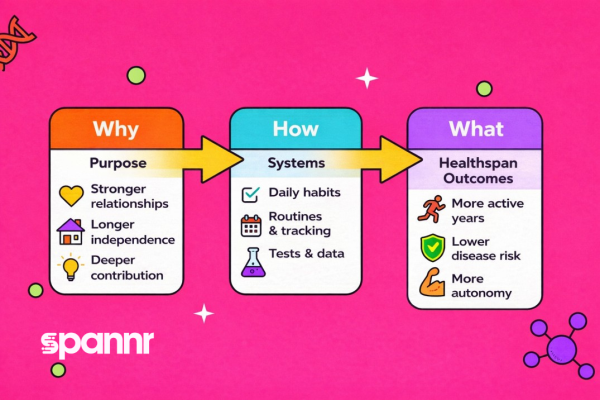
Longevity is rational when it’s framed as more capable years, not more years. The “why” is relationships, autonomy, curiosity, and contribution, and the “how” is systems: routines, feedback, and social infrastructure that survive real life.
What Longevity Is Actually For?
Let’s address the side-eye head on. Longevity is not “I want to look 30 forever,” and it’s not “I refuse to accept death.” Those are the two default bad takes, vanity and fatalism, and both miss what most people actually want: more years where your body can do what your mind, values, and purpose demand.
That looks like traveling without the “we waited too long” regret. Riding trails with your adult kids. Meeting grandkids and having the mobility to get on the floor with them. Staying cognitively intact enough to recognize yourself and your life. This isn’t ego. It’s long-range love plus basic dignity.
Importantly, this framing is measurable. Longevity is not about magical immortality. It is about reducing the probability of slow, expensive decline. If your plan doesn’t make your 70s and 80s more mobile, more cognitively intact, and more autonomous, it isn’t a longevity plan. It’s a cosplay routine.
Why Chasing Longevity Isn’t Futile?
The “isn’t this all pointless?” question usually arrives wearing a Longevity Escape Velocity mask. LEV is the hypothesis that scientific progress could eventually extend remaining life expectancy faster than aging itself progresses. It is uncertain, debated, and not something anyone can promise. But it is also not a joke. It has been discussed in longevity science for decades and defined in clear actuarial terms.
The rational stance does not require certainty. Even without LEV, the expected value is high if you buy yourself ten more active, independent years. More time with family. More time doing work that matters. More time compounding skills, relationships, and meaning.
In business terms, this is not “buying immortality.” It is buying options on future medicine. That is a sensible portfolio decision, provided you do not bankrupt your present life to fund the thesis.
How We Make Longevity Stick (So It’s Not a Hobby)?
This is the unglamorous truth: longevity succeeds or fails on psychology and infrastructure.
The personality trait most consistently associated with longer life is not “biohacker” or “gym rat.” It is conscientiousness, being organized, reliable, and systems-driven. Large longitudinal data sets show conscientiousness predicts longevity even after accounting for other variables. The winners are not the most extreme. They are the most consistent.
Consistency is driven by autonomous motivation, not guilt. When health behaviors align with personal values rather than shame or pressure, adherence improves. Self-determination research in health behavior change consistently links autonomy-supportive motivation with better outcomes. Translation: “I should do this” collapses. “I want this because it protects what I care about” lasts.
Optimism matters too, but not as a motivational poster. In large cohorts, optimism is associated with longer lifespan and higher odds of exceptional longevity. Optimistic people invest in a future self they genuinely believe will exist. When setbacks happen, they re-engage instead of spiraling.
If you want this to work, think in systems, not vibes:
Foundation (cheap or free):
Sleep timing, strength training twice weekly, daily movement, a protein-forward first meal, and one real conversation per day.
Feedback (simple):
Basic labs and one wearable you trust, enough to steer, not enough to drown.
Optimization (optional, later):
CGM sprints, advanced labs, or clinician-supervised therapeutics only after you can execute the foundation for six to twelve months.
What’s Next: Your “Don’t Die For What?” System
If longevity is the “why,” systems are the “how,” but purpose is the glue.
Purpose in life is associated with lower mortality risk across studies and populations. You do not need a philosophical manifesto. You need a sentence your brain cannot ignore:
“Don’t die before I ______.”
Walk my daughter down the aisle. Ride a multi-day trail with my son when he’s 30. Meet my grandkids and be the grandparent who gets on the floor. Finish the body of work I am here to build.
From there, purpose becomes infrastructure:
> A 10-year capability target for what your body should be able to do
> A 1-year health target for what you are improving now
> A calendarized system with fixed sleep windows and scheduled strength sessions
> Social leverage through one accountability partner and one weekly metric
Here is the hard truth: loneliness is not just sad. It is biologically expensive. Social isolation and loneliness are associated with increased mortality risk on par with established risk factors. A longevity plan without social infrastructure fails quietly.
If you want a practical brain-health multiplier that also locks habits in place, learn something hard in public. Structured second-language learning in older adults produces functional brain changes supporting neuroplasticity. Musical instrument training in later life is associated with preserved or improved cognitive outcomes. The goal is not mastery. The goal is forward motion, identity, and feedback.
Longevity is rational. Not because we are trying to beat death. But because we are trying to earn more capable time for the people and work we love, and then build systems that run when motivation doesn’t.
FAQs about Longevity Purpose
Is longevity just vanity or fear of death?
Not when framed as healthspan, more capable years for relationships, contribution, and autonomy.
Do I need to believe in longevity escape velocity for this to be worth it?
No. Even modest healthspan gains deliver major return; LEV is upside, not the foundation.
What makes longevity practices actually stick long-term?
Systems, calendarized routines, feedback loops, and social accountability, not motivation.
Does purpose really affect lifespan?
Evidence links higher purpose in life with lower mortality risk through behavior, stress, and resilience pathways.
What’s the simplest place to start this week?
Write your “Don’t die before I ____” line, schedule one foundation habit, and add one accountability partner.
Disclaimers
Medical disclaimer:
Content is for educational purposes only and is not medical advice. Always consult a qualified healthcare professional before making changes to your health regimen.
Affiliate disclosure:
Spannr may receive compensation when you click partner links and make a purchase. As an Amazon Associate, we earn from qualifying purchases.
HIPAA/PHI notice:
Do not send personal medical information to this inbox. Spannr does not collect or store PHI via email.
About the Author