DEXA Scans: The Two Different Tests, What They Cost, and How to Read Your Results
DEXA Scans: Cost, Accuracy, and What the Numbers Actually Mean
Most people find out they have low bone density or high visceral fat by accident. A doctor orders a scan for some unrelated reason, or a fitness app spits out a body-fat percentage that doesn't match what the mirror says, and suddenly they're Googling terms they've never seen before.
I track my own numbers on purpose. Bone density, lean mass, visceral fat the things a bathroom scale can't tell you and a routine physical usually won't check. A DEXA scan is how I do it, and it's one of the few tests that gives you years of warning before anything goes wrong.
This is the breakdown I wish someone had handed me before my first scan: which of the two DEXA scans you actually need, what each one costs, how accurate they really are, and what your numbers mean once you have them.
The Short Answer: DEXA Scan
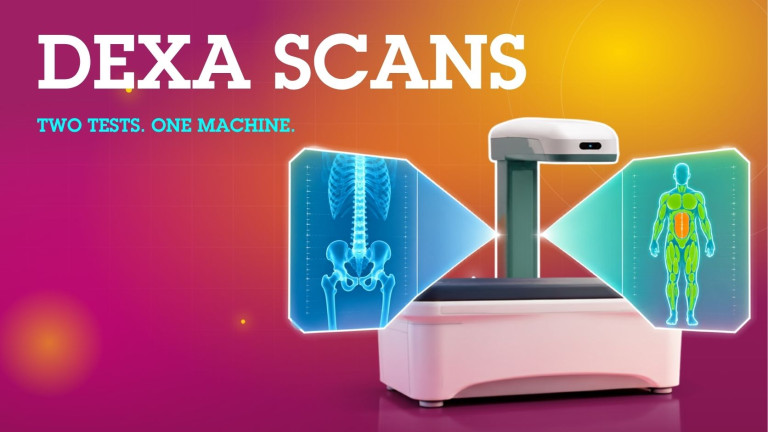
A DEXA scan uses two low-dose X-ray beams to measure either bone density (a diagnostic test for osteoporosis) or full body composition: fat, muscle, visceral fat, and bone (a wellness test). Same technology, two different products.
- T-score of -1.0 or higher means healthy bone density; -2.5 or lower means osteoporosis, but those categories only apply to postmenopausal women and men 50 and older. Younger adults read the Z-score instead.
- Visceral fat (VAT) area under 100 cm² is generally considered low risk; above 160 cm² is considered high risk.
- Expect to pay $40–$200 for a wellness body-composition scan, or $150–$400 for a hospital bone-density scan without insurance. (Pricing as of September 2026.)
- Retest cadence depends entirely on the goal. Bone density moves slowly; body composition doesn't.
Those five points cover the basics. The rest of this is for once you've got a report in front of you.
What Is a DEXA Scan, Exactly?
DEXA stands for dual-energy X-ray absorptiometry. Two low-energy X-ray beams pass through your body at once, and because bone, fat, and lean tissue each absorb radiation differently, the machine can separate all three in a single pass.
A quick naming note: you'll see this test written as both DEXA and DXA. They're the same thing. Cleveland Clinic notes that clinicians have largely moved to "DXA", even though "DEXA" is still what most people search for and what most wellness providers put on their booking page. If your paperwork says DXA, nothing has changed.
The scan itself takes 10 to 30 minutes depending on the type and the machine. You lie flat on an open table while a scanning arm moves slowly overhead. No needles, no contrast dye, no claustrophobic tube.
Central vs. peripheral: the scans that matter clinically are central DXA spine and hip. You may also run into peripheral devices that measure a finger, wrist, or heel, often at health fairs, pharmacies, or gym pop-ups. Mayo Clinic notes these are useful for rough screening but aren't as accurate as spine or hip testing, and a low peripheral result usually triggers a follow-up central scan anyway. If someone offers you a heel scan and calls it a bone density test, that's not the same test your doctor means.
The Two DEXA Scans Nobody Explains Clearly
Here's the part that trips almost everyone up: "DEXA scan" refers to two different tests that happen to run on the same machine.
A bone-density DEXA (billed under CPT code 77080 for the spine and hip) is diagnostic. A physician orders it to screen for or monitor osteoporosis, and because it's a medical test, insurance frequently covers it when you meet the criteria.
A body-composition DEXA measures fat, muscle, and visceral fat across your whole body. Insurers treat it as elective wellness testing, so it's almost always self-pay, which is exactly why fitness-focused providers can price it well below a hospital.
Mixing these up wastes money in both directions. A hospital bone-density scan won't hand you a visceral fat number, and a fitness body-composition scan won't satisfy a doctor screening you for osteoporosis.
One trap worth knowing about: your wellness body-composition report will show a whole-body bone density figure. Don't read it as a diagnosis. UVA Radiology is explicit that whole-body bone density from a composition scan isn't used to diagnose osteopenia or osteoporosis. A low number there is a reason to ask for a proper spine-and-hip scan, not a result you can act on. Diagnosis happens at specific measurement sites, and whole-body isn't one of them.
Who Should Actually Get a Bone-Density Scan?
This is the question the cost articles skip, and it's the one that determines whether you should be booking anything at all.
The CDC's guidance is that osteoporosis screening is recommended for women 65 and older, and for women 50 to 64 who have certain risk factors such as a parent who broke a hip. Other risk factors also count regardless of age or sex, including some intestinal disorders, multiple sclerosis, and low body weight.
Mayo Clinic adds several specific flags that should prompt a conversation with your doctor at any age:
- You've lost height 1.5 inches or more can signal small spinal fractures
- You've broken a bone from something minor (a fall from standing height, a cough)
- You take long-term steroid medication such as prednisone
- Your hormone levels have dropped after menopause, or from certain cancer treatments
Going the other direction, the American Academy of Family Physicians' Choosing Wisely recommendation advises against DEXA screening for osteoporosis in women under 65 or men under 70 who have no risk factors. If you're 45, healthy, and just curious about your bones, a diagnostic scan is probably not the right purchase; a wellness composition scan might be, but that's a different decision.
Where FRAX comes in: For postmenopausal women under 65, the deciding factor usually isn't age but calculated fracture risk. FRAX is the standard tool: it estimates your 10-year risk of hip and major osteoporotic fracture from clinical factors, and it can be run without a bone density result to decide whether you need one.
If you're in that under-65 grey zone, that's the conversation to have with your doctor, and it's worth knowing how to vet a prevention-focused physician before you have it.
Do This Now: Before you book anything, figure out which category you're in. Meeting screening criteria means asking your physician for a diagnostic scan that insurance may cover. Not meeting them, but wanting body composition data, means booking a self-pay wellness scan directly. Booking the wrong one is the single most common and most expensive mistake with this test.
How to Read Your DEXA Results
Getting scanned is the easy part. Knowing what the printout means is where most people give up and skim to the summary page. Don't.
T-Score, Z-Score, and What Osteopenia Actually Means
Your bone-density results come back as a T-score, which compares your bone density to that of a healthy young adult. Per Mayo Clinic:
| T-score | What it means |
| -1.0 and above | Healthy bone density |
| Between -1.0 and -2.5 | Osteopenia below healthy levels, not yet disease |
| -2.5 and below | Likely osteoporosis |
You'll also get a Z-score, which compares you to other people of your age, sex, weight, and racial or ethnic background rather than to a young adult.
Here's the caveat almost nobody publishes, and it matters enormously if you're under 50. Those T-score categories are built for postmenopausal women and men 50 and older. The International Society for Clinical Densitometry's Official Positions state that for premenopausal women and men younger than 50, the Z-score is the number to read, not the T-score, and that osteoporosis cannot be diagnosed in men under 50 on bone density alone. In that group, a Z-score of -2.0 or lower is classified as "below the expected range for age," which is a prompt to look for an underlying cause, not a diagnosis in itself.
So a T-score of -1.3 at 38 is not the same finding as a T-score of -1.3 at 68, and it should not be read as osteopenia. If you're a younger adult who got a scan out of curiosity and came back with a mildly negative T-score, look at your Z-score before you lose any sleep and bring both to a doctor rather than self-interpreting.
For context on why any of this matters: the CDC reports that nearly 1 in 5 women and 1 in 20 men over 50 are affected by osteoporosis. It's common, it's silent until a fracture happens, and it's one of the few conditions where a single scan buys you years of warning.
Do This Now: If your T-score is below -1.0 and you're a postmenopausal woman or a man over 50, ask your doctor whether resistance training, vitamin D, and calcium intake are enough on their own, or whether medication belongs in the conversation. If you're younger, ask them to interpret your Z-score instead.
What Is a Good Visceral Fat Rating on a DEXA Scan?
This is the number most people have never heard of and should be watching most closely. Visceral adipose tissue (VAT) is the fat packed around your internal organs, not the fat you can grab with your hand.
Your report will show VAT as an area, usually in square centimetres. The thresholds most widely used in DXA research and clinical interpretation come from the body-composition literature: under 100 cm² is low risk, 100–159 cm² indicates increased cardiometabolic risk, and 160 cm² or above is considered high risk.
Two honest caveats. These thresholds are not sex-specific, and they're not a formal clinical guideline in the way the T-score cut-offs are. A systematic review of VAT and mortality noted that VAT cut-offs vary widely across studies and that pooling the data is genuinely difficult. Treat 100 and 160 as useful orientation points, not as a diagnosis.
That said, the direction of the evidence is consistent: total body fat percentage gets all the attention, but VAT tracks more directly with insulin resistance, fatty liver, and cardiovascular risk. Two people can have the same body fat percentage, completely different VAT numbers, and completely different risk profiles.
Do This Now: If your VAT area is above 100 cm², don't panic; start there. Aerobic exercise and an overall calorie deficit are the interventions with the most consistent evidence behind visceral fat reduction; Zone 2 work is a practical way to accumulate that aerobic volume without wrecking your recovery. Recheck in 8 to 12 weeks.
Related reading: how Zone 2 and interval training divide the work in a longevity-focused routine.
Body Fat Percentage: Why There's No Single "Good" Number
Body fat percentage is the most-searched number on a DEXA report, and it's the one with the weakest ground under it.
There is no professional consensus on adult body fat percentage cut-offs. The most commonly cited thresholds 25% for men and 35% for women as an obesity marker come from an American Association of Clinical Endocrinologists suggestion, not from a body of outcome data the way the T-score cut-offs are. Meanwhile, NHANES has published DXA-derived reference values by age, sex, and ethnicity, which is a far more useful frame.
The practical implication: ask where your number sits as a percentile for your age and sex, not whether it clears some universal target. A 55-year-old man at 24% and a 25-year-old man at 24% are in very different places relative to their peers, and neither number means anything on its own.
Two more things that make cross-comparison unreliable: DXA body fat percentage is not directly comparable between manufacturers, and it's not comparable to whatever your smart scale says. Your own trend on one machine is the only clean comparison you have.
Lean Mass, ALMI, and Why Muscle Is the Number to Watch After 40
Lean mass is everything on your scan that isn't fat or bone mostly muscle. Your report may also break out appendicular lean mass index (ALMI), which measures the muscle in your arms and legs relative to your height.
Low ALMI is one of the clearer warning signs for sarcopenia, age-related muscle loss, which is consistently linked to worse long-term health outcomes independent of body fat. Past 40, this is the number I pay more attention to than body fat percentage.
Muscle is the tissue most people never think to measure until it's already declining. Bone density gets the headlines; lean mass is what keeps you mobile and independent as you age.
I get into this exact tension tracking often enough to catch a real trend without chasing daily noise on The Longevity Loop podcast.
How to Track Your DEXA Numbers Across Scans (Template)
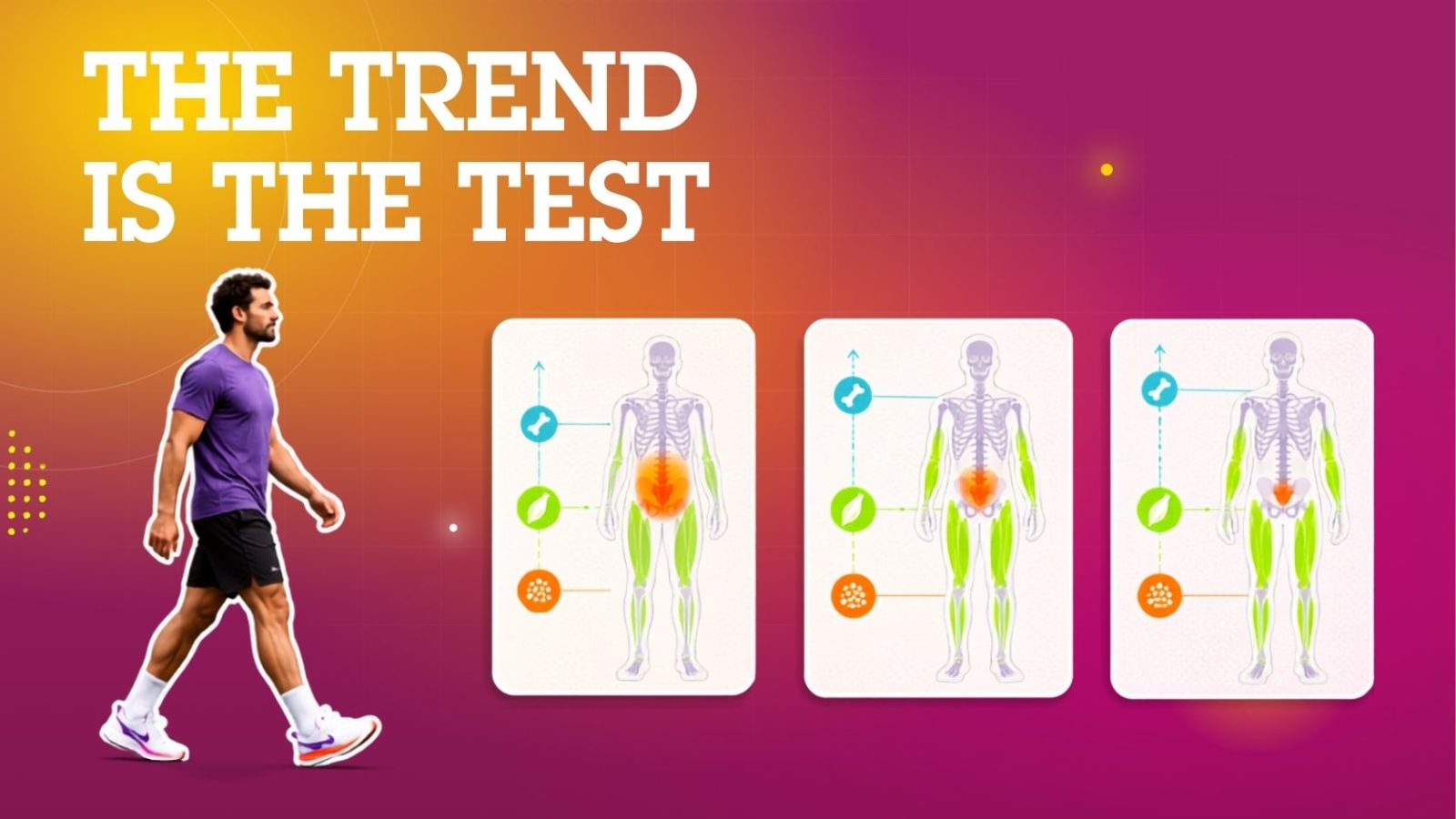
One scan tells you where you stand. A series tells you whether what you're doing is working. Here's the tracking format I use.
The numbers below are illustrative; they show the shape of a trend line so you can see what you're looking for. They aren't anyone's real results. Swap in your own as you collect them.
| Scan | Bone Density T-score | Lean Mass (lb) | Visceral Fat (VAT, cm²) |
| Scan 1 (baseline) | -0.8 | 142 | 118 |
| Scan 2 (+3 months) | -0.7 | 146 | 104 |
| Scan 3 (+6 months) | -0.6 | 149 | 91 |
The direction matters more than any single number. Bone density inching toward zero, lean mass climbing, visceral fat dropping out of the elevated range that's a trend worth training for.
Do This Now: Pull your last two DEXA reports and just look at the direction of each number. If you've only had one, that's your baseline. Book the next one 8 to 12 weeks out if you're actively training, or 6 to 12 months out if you're monitoring.
How to Prepare for Your Scan
Prep matters more than most providers tell you, and it matters most if you're tracking a trend. Inconsistent preparation is one of the largest sources of scan-to-scan noise, and it can easily manufacture a "change" that never happened.
For a bone-density scan, Mayo Clinic advises:
- Skip calcium supplements for 24 hours beforehand
- Wear loose clothing with no zippers, buttons, or belts; leave jewellery at home
- Tell the team if you've recently had a barium study, CT contrast, or a nuclear medicine scan; residual material can interfere.
- Tell them if you're pregnant or might be
For a body-composition scan, add consistency rules. Food, hydration, glycogen status, and recent training all shift measured lean mass, because DXA counts the water held in muscle as lean tissue. Before each scan, try to keep these roughly the same as last time:
- Time of day
- What and how much you ate beforehand
- Hydration (normal: don't load up, don't dehydrate)
- Whether you trained that morning
- What you're wearing
What you should not do is manipulate the result. Saunas, aggressive fasting, carb depletion, and last-minute "cutting" will move the number without moving anything real, and they'll wreck the comparison you paid for.
How Often Should You Get a DEXA Scan?
This is where most articles get it wrong, because two very different questions are hiding behind one number.
For diagnostic bone-density screening: there is no single correct interval, and it's almost certainly longer than you think. The US Preventive Services Task Force declines to set a fixed screening interval, and notes that cohort studies suggest repeating bone density testing at intervals of 4 to 8 years doesn't improve fracture prediction. The commonly quoted "every 1 to 2 years" figure is a treatment-monitoring interval; AACE/ACE and the Bone Health and Osteoporosis Foundation recommend repeating DEXA every 1 to 2 years until findings are stable, then as clinically warranted. That's for people on treatment or with a borderline prior result, not for everyone.
Choosing Wisely Canada's rheumatology recommendation goes further, advising against repeating DEXA more often than every two years. Medicare's 24-month coverage floor reflects the same reality: bone simply doesn't move fast enough to justify checking more often unless the result would change your treatment.
For body-composition tracking: the clock runs much faster. If you're actively cutting fat or building muscle, every 8 to 12 weeks gives your body enough time to show a real, measurable change without the result getting muddied by water weight and daily fluctuation. If you're maintaining, every 6 to 12 months is plenty. There's no medical limit here; these are self-pay wellness scans, and the constraint is your budget and whether the number will actually change.
Conflating these two clocks is how people either waste money over-scanning their bones or under-track their body composition.
Do This Now: Pick your goal first, then pick your cadence. Training for a body recomposition? Book your next scan 8 to 12 weeks out and put it on the calendar now, not when you remember. Screening your bones? Ask your doctor what interval your specific result warrants; don't default to annual.
What Does a DEXA Scan Cost?
The price range for a "DEXA scan" spans roughly $40 to $400, and that gap makes sense once you remember these are two different products.
| Setting | Typical 2026 out-of-pocket cost |
| University/research lab (body composition) | $40–$80 |
| Independent DEXA clinic or mobile service | $99–$175 |
| Longevity, med-spa, or concierge clinic | $175–$250+ |
| Hospital bone-density scan (CPT 77080), no insurance | $150–$400 |
Body-composition scans typically run $40 to $200 per session, with membership pricing pushing toward the lower end. Hospital-billed bone-density scans run $150 to $400 before insurance; MDsave reports a median uninsured price of roughly $337 for a standard axial (spine and hip) scan. (Pricing as of September 2026; confirm with your provider before booking.)
Three things drive most of that spread: hospital versus independent provider, whether the scan is billed as medical or elective, and your local market.
Does Insurance or Medicare Cover a DEXA Scan?
Medically-ordered bone-density scans are frequently covered by private insurance when a physician documents medical necessity, fracture history, long-term steroid use, or age-based screening criteria.
Medicare Part B covers a bone mass measurement once every 24 months, or more often if medically necessary, for beneficiaries who meet specific conditions. Two caveats that get dropped constantly and cost people money:
- Coverage isn't automatic for everyone on Medicare. You have to meet Medicare's risk criteria, for example, being certified at risk for osteoporosis due to oestrogen deficiency, showing X-ray evidence of osteopenia or vertebral fracture, taking long-term steroids, having primary hyperparathyroidism, or being monitored on osteoporosis treatment.
- "No cost" depends on assignment. You pay nothing only when the provider accepts Medicare assignment. If they don't, you can be billed for part or all of it. Ask before you book.
Body-composition DEXA scans are a different story. Insurers classify them as elective wellness testing, so they're almost always self-pay.
Can You Use HSA or FSA Funds?
Usually, yes, but with a caveat the marketing pages leave out.
DEXA scans are listed as eligible expenses by the major HSA/FSA administrators, and IRS Publication 502 treats diagnostic body scans as medical care. In practice, many claims clear with nothing more than an itemised receipt.
However, some administrators will ask for a letter of medical necessity when the scan is framed primarily as weight loss, fitness, performance, or general wellness rather than as diagnosis. That's exactly how most body-composition scans are marketed.
Practical advice: check your plan administrator's rules before booking, keep the itemised receipt with the date, service description, provider name, and amount, and don't assume reimbursement is automatic just because a card swipe went through. Card approval at checkout isn't the same as full substantiation.
Is a DEXA Scan Accurate?
Short answer: yes. DXA is the clinical reference standard for both bone density and body composition, and nothing else available to consumers is close.
The comparison that matters most is against the bioelectrical impedance (BIA) scales built into bathroom scales and gym devices. The gap is not subtle. In a study of nearly 200 adults, BIA underestimated body fat percentage relative to DXA by about 4.6 percentage points in men and 5.1 in women, with limits of agreement spanning roughly 15 percentage points. That's not a rounding error; that's the difference between two entirely different assessments of the same person.
The caveat worth knowing: results vary between different manufacturers' machines. Hologic and GE HealthCare Lunar are the two most common because each brand's software calculates visceral fat and lean mass slightly differently. That doesn't make DXA unreliable. It means the number that matters isn't any single scan; it's the trend from repeated scans on the same machine, or at minimum the same brand.
Certain conditions can also distort bone-density readings specifically. Mayo Clinic notes that spinal conditions such as arthritis or scoliosis, and past spine surgery, can make results less accurate and that spine and hip measurements are more accurate than forearm, finger, or heel testing.
Do This Now: If you're tracking progress over months or years, stick with the same provider and machine. Switching locations isn't disqualifying, but treat the first scan at a new location as a fresh baseline rather than a continuation of the old trend.
DEXA vs. BodPod, InBody, and the Alternatives
| Method | Typical cost | What it measures | Main limitation |
| DXA | $40–$200 | Fat, lean mass, VAT, bone with regional breakdown | Small radiation dose; results not comparable across manufacturers |
| BodPod (air displacement) | $40–$80 | Total fat and lean mass | No regional or visceral breakdown; sensitive to clothing and hair |
| BIA / InBody | $0–$50 | Estimated fat, lean mass, body water | Consistently underestimates body fat vs. DXA, with wide individual error |
| Hydrostatic weighing | $50–$150 | Total fat and lean mass | Requires full submersion and maximal exhalation; increasingly rare |
| 3D body scanners/smartphone apps | Often free | Circumference-derived estimates | Estimation, not measurement; useful for shape change, not composition |
The short version: if you only care about total body fat percentage and you want it cheap, BodPod is defensible. If you want visceral fat, regional lean mass, and bone in one pass, which is the entire reason to bother, DXA is the only option at consumer prices.
DEXA Scan Radiation and Safety: What the Data Shows
A DEXA scan uses X-rays, and it's reasonable to want an actual number rather than reassurance.
Effective doses for whole-body DXA are typically reported in the range of 1 to 10 microsieverts, depending on the machine and the scan. For comparison, the International Atomic Energy Agency puts a chest radiograph at 20 to 50 microsieverts, and notes that most DXA systems deliver less than that, though some newer fan-beam and cone-beam systems approach chest X-ray levels, so the "far less than an X-ray" line you'll see on clinic websites isn't universally true.
Either way, the dose is in the same neighbourhood as a day or so of ordinary background radiation. The CDC assesses that a DEXA scan carries a very slight increase in the possibility of future cancer, similar to the risk from a standard X-ray.
The one clear exception: DEXA is avoided during pregnancy, as a general precaution around any added radiation exposure rather than because of anything specific to this test. Tell your provider if there's any chance you're pregnant.
What a DEXA Scan Can't Tell You (Including Cancer)
People searching for DEXA information keep landing on one specific worry: can it find cancer? No. A standard DEXA scan is not built to detect cancer, and no radiologist would use one for that purpose. It measures density and composition; it doesn't visualise soft tissue or cellular change the way a CT, MRI, or PET scan does.
Part of the confusion is a naming collision. A bone density test and a bone scan are different procedures. Mayo Clinic draws the distinction directly: a bone scan involves an injected tracer and is typically used to look for fractures, infections, or cancer in bone. A bone density test involves no injection. If a doctor says "bone scan," ask which one they mean.
Where DEXA does appear in cancer care is as monitoring, not screening: patients on aromatase inhibitors for breast cancer or on long-term steroids are at elevated risk of bone loss, so oncologists often order baseline and follow-up DEXA scans to protect bone health during treatment. That's tracking a side effect, not looking for the disease.
DEXA also can't tell you why your bone density is low, only that it is. Mayo lists this explicitly as a limitation; finding the cause takes other tests.
What to Do With Your Results
A DEXA report without a plan is just an expensive PDF. Here's how I'd triage one.
| If your goal is... | Get this DEXA type |
| Screening for osteoporosis or checking fracture risk | Bone-density DEXA, ordered by your physician |
| Tracking fat loss, muscle gain, or visceral fat over time | Body-composition DEXA at a wellness or fitness provider |
Worked example: Say you're a 62-year-old man whose first scan comes back with a T-score of -1.3, a VAT area of 145 cm², and lean mass on the lower end for your height. That's not a crisis; it's a to-do list. The bone number puts you in the osteopenia range for your age group, which is a conversation with your doctor about resistance training and vitamin D status, not a prescription. The VAT number sits in the elevated band, which points toward aerobic volume and cleaning up overall intake. The lean mass number points toward progressive resistance training if it isn't already in your week.
If you were 38 instead of 62, that same -1.3 T-score wouldn't be read as osteopenia at all; your doctor would look at your Z-score instead. Age changes the interpretation, not just the response.
None of those three actions conflict with each other. That's the advantage of getting the full picture in one scan instead of guessing from the mirror.
DEXA Scan FAQs
Do I need a doctor's referral for a DEXA scan?
It depends on which scan. A diagnostic bone-density DEXA is ordered by a physician and billed as a medical test. A body-composition DEXA at a wellness or fitness provider is self-pay and usually bookable directly, no referral needed. If you want an osteoporosis diagnosis, you need the first one.
What does a DEXA scan cost?
Body-composition scans typically run $40 to $200 at wellness providers, while hospital bone-density scans run $150 to $400 without insurance, with a national median near $337. (Pricing as of September 2026.) Medicare Part B covers a bone-density scan once every 24 months for beneficiaries who meet its risk criteria, at no cost when the provider accepts assignment.
How should I prepare for a DEXA scan?
Wear clothing without metal, and skip calcium supplements for 24 hours beforehand. Tell the technologist if you've recently had barium or contrast imaging, or if you could be pregnant. For body-composition tracking, keep food, hydration, and training roughly consistent before each scan; inconsistent prep is a common source of scan-to-scan noise.
Does a T-score mean the same thing at every age?
No. T-score categories apply to postmenopausal women and men 50 and older. For premenopausal women and men under 50, ISCD guidance says the Z-score is the number to read; a Z-score at or below -2.0 is "below the expected range for age" and prompts a look for an underlying cause rather than a diagnosis.
What is a good visceral fat rating on a DEXA scan?
A VAT area under 100 cm² is generally considered low risk. Between 100 and 159 cm² indicates increased risk. At 160 cm² and above, it's considered high risk for cardiovascular and metabolic disease. These are research-derived orientation points, not sex-specific clinical cut-offs.
How often should you get a DEXA scan?
It depends on the goal. For bone-density screening, there's no fixed interval; the USPSTF sets none, and intervals are often much longer than two years for people with normal results. For body composition, every 8 to 12 weeks if you're actively training or cutting, or every 6 to 12 months for general tracking.
What's the difference between a DEXA scan and a bone scan?
They're different tests. A DEXA scan measures bone density with low-dose X-rays and no injection. A bone scan involves an injected tracer and is used to look for fractures, infections, or cancer in bone. If your doctor said "bone scan," ask which one they mean.
Can a DEXA scan show cancer?
No. DEXA measures bone density and body composition, not tumours or soft tissue. Oncologists use CT, MRI, PET, or dedicated bone scans for cancer detection, though DEXA is sometimes used to monitor bone health in patients on certain cancer treatments.
Are DEXA scans accurate for bone density?
Yes, DXA is the clinical reference standard for bone density. Results vary slightly between machine manufacturers, which is why tracking a trend on the same machine matters more than comparing single scans across providers.
What are the disadvantages of a DEXA scan?
The main downsides are minor: variation between manufacturers' machines, no ability to identify why bone density is low, reduced accuracy in people with spinal arthritis, scoliosis, or prior spine surgery, and a very small radiation dose. It's avoided during pregnancy as a precaution.
Does insurance cover DEXA scans?
Often yes for medically ordered bone-density scans when you meet the criteria. Medicare Part B covers one every 24 months for qualifying beneficiaries at no cost when the provider accepts assignment. Body-composition scans are almost always self-pay, though HSA/FSA funds often qualify with an itemised receipt.
Final Thoughts
A DEXA scan won't fix anything by itself. What it does is replace guessing with an actual number for your bones, your muscle, and the fat you can't see in the mirror.
If you take one thing from this: know which scan you're booking before you book it. Bone density and body composition are different tests solving different problems, and most of the confusion people have about DEXA scans traces back to that one mix-up.
If you're evaluating a longevity clinic and DEXA is part of what they offer, it helps to know first what these clinics actually test and charge for, then ask three things: which machine do they use, how do they interpret VAT and ALMI, and what retest cadence do they recommend for your specific goal?
⚠️ Spannr's Longevity 101 guide and Spannr's glossary cover additional biomarkers worth tracking alongside bone density and lean mass. If you're looking for a doctor who treats these numbers instead of dismissing them as "normal for your age," Spannr's longevity clinic directory is a good place to start.
About the author
Brent Wallace has worked in the longevity space for over a decade and holds a nutrition credential from the Institute for Integrative Nutrition (IIN). He tracks his own biomarkers and DEXA scans as a matter of routine.
Medical disclaimer
I'm not a doctor, and I don't pretend to be one. This article is written by Brent Wallace, based on his own tracked biomarker data and protocols, and cross-checked against the clinical guidance and peer-reviewed research cited throughout.
This is for educational purposes only and isn't a substitute for personalised medical advice. Talk to your doctor, ideally one familiar with bone health and body composition, before changing any health protocol based on what you read here. If your results concern you, take the report to a clinician rather than acting on the numbers alone.
- https://www.mayoclinic.org/tests-procedures/bone-density-test/about/pac-20385273
- https://my.clevelandclinic.org/health/diagnostics/10683-dexa-dxa-scan-bone-density-test
- https://www.cdc.gov/radiation-health/data-research/facts-stats/dexa-scan.html
- https://iscd.org/official-positions-2023/
- https://www.uspreventiveservicestaskforce.org/uspstf/recommendation/osteoporosis-screening
- https://www.aafp.org/family-physician/patient-care/clinical-recommendations/choosing-wisely.html
- https://www.medicare.gov/coverage/bone-mass-measurements
- https://www.iaea.org/resources/rpop/health-professionals/other-specialities-and-imaging-modalities/dxa-bone-mineral-densitometry/patients
- https://blog.radiology.virginia.edu/why-should-i-get-a-dexa-body-composition-scan/
- https://www.frontiersin.org/journals/rehabilitation-sciences/articles/10.3389/fresc.2021.712977/full
- https://pmc.ncbi.nlm.nih.gov/articles/PMC9446237/
- https://ajcn.nutrition.org/article/S0002-9165(23)02699-0/fulltext
- https://pmc.ncbi.nlm.nih.gov/articles/PMC2737140/
- https://pmc.ncbi.nlm.nih.gov/articles/PMC3613423/
- https://www.niams.nih.gov/health-topics/bone-mineral-density-tests-what-numbers-mean
- https://www.radiologyinfo.org/en/info/dexa
About the Author