CellCore Comprehensive Protocol Review: My 10 Months, 6 Kits, and Results
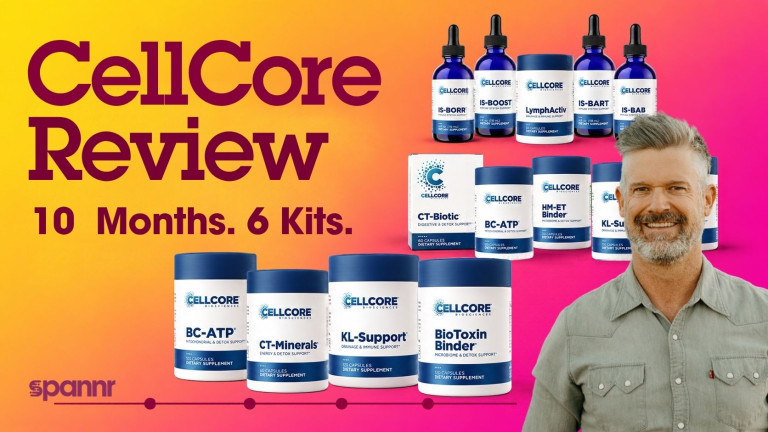
CellCore Comprehensive Protocol Review: My 10 Months, 6 Kits, and Results
I spent ten months on CellCore's five-phase Comprehensive Protocol, and I'd give it an eight out of ten. My standard blood panel barely moved, my OligoScan heavy-metal readings dropped from yellow-and-red into green-and-yellow, and I lost about five pounds I wasn't trying to lose, which I've logged as a neutral finding, not a win.
I'm Brent Wallace. I run growth for longevity clinics, I'm a health coach certified by the Institute for Integrative Nutrition, and I'm not a physician. This is one person's experience, not a study. It was rough on a fit guy in his early fifties who trains hard, so if you're managing a diagnosed condition, don't run this without someone supervising you.
I also have a referral relationship with CellCore, so factor that in as you read; I've tried to be just as thorough about what didn't work as what did.
What I'd Want to Know Before Starting the Comprehensive Protocol
- Five phases, six kits, roughly nine months by design. Mine took ten with travel breaks.
- Practitioner-only. No retail channel, no legitimate checkout without a patient code.
- The hardest part wasn't the supplements. It was two weeks of heavy brain fog I caused myself by running full strength.
- Adding Carboxy about an hour after the tinctures fixed most of the fog and the nausea.
- My standard biomarkers barely moved. The OligoScan readings did, and OligoScan has real limitations. I'll walk through honestly.
- If you take prescription medication, read the binder section before you buy anything. Binders and fiber can blunt how well your body absorbs what you swallow alongside them.
How I tracked this
Worth knowing before you weigh anything below:
- What I measured: a standard blood panel before and after, and OligoScan heavy-metal readings at intervals through the protocol.
- What OligoScan is: a handheld palm scanner, not a lab test. Full explanation of its limitations further down, and you should read it before you read anything into my numbers.
- What I didn't control for: sauna two to three times a week throughout, and added fiber partway through. No control group. One person, several changes at once.
Why a Dentist Was the One Who Told Me to Detox
My dentist recommended it. She's a biological dentist, extremely thorough, ran a four-hour intake with a full set of tests, and she's the one who recommended CellCore; specifically, that's a big part of why I trusted it.
I'd tested high for heavy metals on an OligoScan. I wasn't feeling bad. I've just never accepted "your labs are fine" as the ceiling.
I'd never done a cleanse at this intensity. Ten months is not a January reset.
What sold me was that this wasn't a zeolite or charcoal product off a health food store shelf. It's practitioner-level, and before I committed a dollar, I Googled the company and read through Reddit threads and other online reviews. CellCore came out ahead of the alternatives I compared, which is why I eventually became a practitioner with them.
Why Not Just Buy a Zeolite Cleanse Off the Shelf?
CellCore Biosciences is a brand of Microbe Formulas LLC, which also owns Biocidin. Their products are primarily intended for exclusive distribution through licensed healthcare professionals, and that channel is the entire brand positioning.
What it buys you is real: dosing documentation written for clinical use, a structured phase order, and a company that has to answer to practitioners rather than to Amazon reviewers.
CellCore publishes figures worth looking at directly: that more than 100,000 people have completed its protocols, and that there is improvement in their patients' gut health, energy, immune strength, and overall well-being.
What about BioActive Carbon?
This is CellCore's central product claim and the reason the formulas cost what they cost. The short version: the products use what CellCore calls BioActive Carbon Technology, built on soil-derived fulvic and humic acids, and the company's argument is that these carbon molecules bind more effectively and travel further than older clay or charcoal binders.
Fulvic and humic substances are real; they're well characterized in soil chemistry, and there's a plausible mechanistic story about their binding behavior.
What I Liked About How the Protocol Is Built
The order of operations is what I liked most. CellCore's own framing is that most detox programs start by pushing toxins out, while theirs prepares the body first so that what's released can move out more efficiently. That sequencing, drainage before mobilization, is the part that separates a considered protocol from a bottle of charcoal.
Do This Now: Before you buy anything, ask your practitioner one question: "What happens if I react badly in Phase 4?" If they don't have a specific answer, you're buying a box, not a protocol.
What Is the CellCore Comprehensive Protocol, Exactly?

It's a five-phase program delivered in six kits, run in order, over roughly nine months.
| Phase | Kit | What's in it | What it's for |
| 1 | Energy and Drainage | BC-ATP, BioToxin Binder, CT-Minerals, KL Support | Open the exit routes and support mitochondrial energy before you mobilize anything |
| 2 | Gut & Immune Support | BC-ATP, BioToxin Binder, Para 1, Advance TUDCA, Para 2 | Work on the terrain where most of the elimination actually happens |
| 3 | Whole Body Immune Support | BC-ATP, ViRadChem Binder, Para 1, LymphActive, Para 3, CT-Minerals | Broaden beyond the gut before systemic work begins |
| 4A | Systemic Detox | BC-ATP, KL Support, HM-ET Binder, Para 4, CT Biotic | The deep end. The first of the two kits that cost me two weeks of my brain |
| 4B | Systemic Detox | BC-ATP, HM-ET Binder, CT Biotic, Advance TUDCA, Metabolic Activator | Continuation of systemic work |
| 5 | Deeper Immune Support | LymphActive, IS-BORR, IS-BART, IS-BAB, IS-BOOST | The close-out phase |
Carboxy sits outside that list. CellCore positions it as additional detoxification support and specifically does not recommend it for the earliest steps. Remember that, because it becomes the most important detail in this entire article.
Comprehensive vs. Foundational: Which One Are You Actually Being Sold?
CellCore's own description is the clearest one available. The Foundational Protocol is a four-month, four-step system aimed at everyday toxic load and mild to intermediate symptoms. The Comprehensive Protocol is the longer program for people with higher toxic burden or more persistent health challenges.
How Long It Takes, and Why Mine Took Ten
Nine months on paper. Ten for me, because I took a one-week break and a two-week break for travel and didn't want to haul six kits through airports. That's about nine and three-quarter months of actual running, which I've rounded to ten throughout.
As far as I can tell, those pauses cost me nothing in the final result.
The structure is the easy part to understand; running it inside a normal life is where people quit.
How I Actually Ran It: Dosing Windows and Real Life

I ran it self-directed, using CellCore's documentation, which is genuinely good. That was a choice I made for myself with a specific risk profile. I wouldn't hand that choice to most people.
Depending on the phase, doses are taken in the morning on an empty stomach, at midday, and in the evening before bed on an empty stomach.
Read that again, because it's the real cost of this protocol. You are organizing three separate empty-stomach windows around work, training, family dinners, and travel, for the better part of a year.
That's not hard. It's relentless. There's a difference, and the difference is what makes people abandon in month four.
What I Added That Wasn't in the Kits
Psyllium husk and chia seeds.
Neither is a detox agent. They don't bind metals, and they don't chelate anything. What they do is support elimination once things are already mobilized, which turns out to matter a great deal.
Both stuck. Psyllium is new for me, and I still eat chia.
Do This Now: Add psyllium or another soluble fiber on day one, not month four. Things get mobilized on this protocol, and mobilized material needs a vehicle out. If you take prescription medication, read the next section before you start; fiber and binders both interfere with absorption.
The Brain Fog Nobody Warns You About
Here's the part I got wrong, and the fix that took two weeks to find.
Somewhere in the deeper phases, 4A, around month six, I hit massive brain fog. Not tired. Not distracted. Fog thick enough that I started wondering what was wrong with me.
For a couple of weeks I didn't connect it to the protocol at all. I traced it eventually, mostly by elimination, and the fix was almost embarrassingly simple: I added Carboxy, taking a dose about an hour after the tinctures.
The fog lifted substantially. So did the nausea.
Honestly, I think I did this to myself. I ran the protocol at full strength from the start because I assumed I could handle it. Someone easing in at half doses probably never feels this at all.
That's not a guess pulled from nowhere. CellCore's own phase documentation acknowledges that mild detox symptoms, bloating, fatigue, constipation, headaches, gas, are possible, that this varies with the individual, and that anyone reacting excessively should introduce supplements one at a time, starting at a half dose.
I skipped that instruction. It cost me two weeks.
What a Binder Actually Does: Mobilization, Capture, Elimination
Here's the mechanism, because almost nobody writing about this protocol explains it well enough to act on.
A binder is a supplement that captures mobilized toxins in the gut so they're eliminated in stool instead of recirculating through the body.
Detox happens in three steps, not one:
- Mobilization: Compounds get pulled out of tissue and into circulation.
- Capture: A binder grabs them in the gut.
- Elimination: They leave the body.
Skip step two, and you haven't detoxed anything. You've just moved the problem into your bloodstream.
Mobilizing metals without a binder in place is just relocating them. That's not detox. That's a commute.
This is why the one-hour gap matters. You want the binder present downstream when mobilized material arrives, not competing with the tinctures on the way in.
Here's the sequence that worked for me:
- Morning, empty stomach: tinctures per the phase dosing card.
- Roughly 60 minutes later: Carboxy dose.
- Midday: dose per the card.
- Evening, empty stomach, before bed: tinctures.
- Roughly 60 minutes later: Carboxy, if the day's dosing calls for it.
- Throughout: fiber and enough water that elimination is actually happening daily.
If you take medication, this section is the one that matters
A binder doesn't know what it's binding. Neither does psyllium. Both can reduce how much of an oral medication your body actually absorbs, and the same is true of some nutrients, which is a second reason mineral support isn't optional here.
CellCore's own guidance advises spacing its supplements away from other things you take, for exactly this reason. That's a general spacing rule, not a personalized one, and it isn't a substitute for asking someone who knows your prescriptions.
If you are on anything, thyroid medication, antibiotics, antidepressants, blood thinners, hormonal contraception, anything at all, confirm timing and spacing with your prescriber or a pharmacist before you start, not after. This is a five-minute conversation that nobody in this space seems to tell you to have.
The Timing Rule I Wish Someone Had Given Me: If I could go back and tell myself one thing, it's this: the binder isn't optional support; it's the second half of the mechanism. I treated Carboxy like a nice-to-have because it's sold separately from the kits. It isn't a nice-to-have. It's the part that turns mobilization into elimination, and buying the kits without it is like buying a snow shovel and no place to put the snow.
Die-Off or Just Bad Timing? Why the Label Changes What You Should Do
You'll see every detox symptom in this space labeled a "Herx" or "die-off." Most of the time that's wrong, and the sloppiness matters.
A Jarisch-Herxheimer reaction describes an inflammatory response to endotoxin released when organisms are killed, classically during treatment of spirochetal infection. It's a specific phenomenon with a specific trigger.
What I experienced was far more likely mobilized compounds circulating without adequate binder coverage. Different mechanism, different fix.
This isn't pedantry. Calling it "die-off" tells you to push through. Calling it what it probably was tells you to add a binder and cut your dose. One of those answers is useful.
It's also worth knowing that mobilizing agents don't discriminate. The American College of Medical Toxicology notes that chelating agents increase urinary excretion of essential minerals including iron, copper, and zinc, alongside whatever else they move. Mineral support during aggressive detox isn't a gimmick.
Do This Now: If you have fog, nausea, or headaches on this protocol, don't push through. Move your binder to roughly an hour after your tinctures and cut your dose in half for a week. If it doesn't resolve, stop and call your practitioner.
The fog was the worst of it, but it wasn't the only hard part.
The Other Hard Parts: Tinctures, Nausea, and Training

The tinctures in the later phases were the roughest thing in the protocol.
I had to ease into them, or I'd get nauseous. They also don't taste good. Shoot them in a couple of ounces of water, chase with plain water, and you're fine. If you're sensitive to taste, you're going to complain about this for months.
Then there's training. I ride hard, and on hard training days the protocol affected me. Some sessions I just didn't feel great, and I stopped scheduling anything demanding on days I was starting a new tincture.
I feel really good now. That's a different sentence than "it was easy," and I'm not going to blur the two.
So after ten months of that, what actually moved?
What Changed, What Didn't, and What I Can't Prove
My standard biomarkers barely moved. Ten months, six kits, and the blood panel looked roughly like it did when I started.
I'm telling you that early, because a review that only reports the wins isn't a review, it's an ad.
I lost about five pounds. I wasn't trying to, and I wouldn't buy this for weight loss.
What did move was the OligoScan. My readings went from yellow-and-red down into green-and-yellow. Not to zero, but down significantly.
Which brings me to the part where I have to be careful with you.
About That OligoScan: What It Is and What It Isn't
OligoScan is a handheld spectrophotometer that scans the palm to estimate tissue mineral and heavy-metal levels. It is not a blood or urine lab test.
That distinction is everything, and I'd rather you hear the criticism from me than find it yourself an hour from now.
Independent validation of the device is limited. I searched the published literature and could not find an independent peer-reviewed validation study for it. A longstanding critical assessment from Quackwatch makes the sharper version of the point: the supporting article list offered by the device's promoters doesn't actually include studies evaluating the device's core claims or demonstrating patient benefit.
Reporting in January 2026 noted that while the technology has spread internationally, independent scientific validation appears limited, and practitioners who use it emphasize it should complement other medical tools rather than replace them.
So here's exactly what I'm claiming. These are my readings, from a device with known limitations, and they moved in the direction I wanted. That's it. I'm not presenting them as clinical proof, and if you run this protocol expecting lab-grade before-and-after evidence, you will be disappointed.
How to Read a Test Result Without Fooling Yourself: Three questions I now ask about any wellness device before I let it change my behavior.
First: has anyone independent published validation of it, or only the manufacturer?
Second: what's the actual measurement: blood, urine, tissue, or an inference from something else?
Third: if this number moved, what would I do differently, and is that action safe if the number is wrong?
If the answer to the third question is "spend thousands of dollars," the first two questions deserve a lot more of your time than they usually get.
If you want the broader version of that argument about where to put your effort first, tiered by how good the evidence actually is, that's what Longevity 101 is for.
The Variables I Can't Separate
One paragraph, stated plainly, and then I'm moving on.
I used a sauna two to three times a week, for 15 to 20 minutes, and I was doing that before the protocol, during it, and after it, which matters, because what sauna use actually does is well studied in its own right.
That means this was one person running several interventions at once with no control group, and there's decent evidence that sweat matters here on its own. A 2011 study of 20 participants found many toxic elements appeared to be preferentially excreted through sweat, with some detected in perspiration that weren't found in serum at all. Twenty people is a small study, and I'm not going to pretend my sauna habit is a clean variable either way.
That's the honest accounting. If the biomarkers didn't move, why do I still think this was worth doing?
Why Environmental Exposure Is Worth Taking Seriously
Because the exposure itself isn't in dispute, even if the intervention is.
The CDC runs the National Biomonitoring Program, which measures environmental chemicals in blood and urine from a nationally representative sample of Americans. The report presents cumulative biomonitoring data gathered from 1999–2000 through 2017–2018, drawn from participants in the National Health and Nutrition Examination Survey. This is the real dataset, and it's public.
Take glyphosate as the worked example. A 2024 analysis of three NHANES cycles between 2013 and 2018 found that between 70.0% and 81.7% of the US population had detectable urinary glyphosate, including children as young as three.
Here's the part nobody in my industry mentions, so I will: concentrations fell about 38% over that same period, likely reflecting changes in agricultural practice, regulation, and public awareness. That's good news. Reporting it is the reason you should believe the rest of this section.
The CDC is also careful in a way supplement marketing never is. Its own guidance states that measuring a chemical in someone's blood or urine is a measure of exposure and does not by itself mean the chemical causes disease or an adverse effect.
Research on detox protocols is still early, which is why I'm sharing my experience instead of promising results.
So I'll tell you what I actually believe rather than what I can prove. I believe the exposure is real. I did this protocol. My readings moved, I feel good, and I'd do it again. That's conviction plus reasoning, and it is not the same thing as evidence.
If you want to understand why this whole category is expanding so fast, the money flowing down from longevity's biggest funders explains most of it.
Do This Now: Reducing what comes in is cheaper and better evidenced than increasing what goes out, and there's a longer list of ways of cutting your everyday exposure at the source: air, water, cosmetics, indoor dust.
Cutting exposure at the source beats chasing it out afterward, which is why we run air purifiers at home. AirDoctor is the one I trust for filtration. I was happy to walk into an Airbnb recently and find one running. Blueair is the other one in our house, and it's the best-looking purifier I've found, which matters when it's sitting in your living room. (Affiliate links. I earn a commission if you buy through them.)
Questions to Ask Before You Buy
- Why Comprehensive instead of Foundational for me specifically?
- Am I buying Carboxy separately, and when do I start it?
- What dose do I start at, and what's the protocol if I react?
- What are we measuring at baseline, and with what kind of test?
If a practitioner can't answer all four without checking, find a different practitioner. The kits are sold individually, so stopping partway means you simply stop buying the next one.
Knowing what I know now, I'd spend it again. I'd spend it differently.
It's a real investment, in money and in ten months of your time. Your practitioner will give you current pricing. For me it was well worth it, especially with the results I got.
What I'd Do Differently
Three changes, and they're all about pace.
Stretch it over more months: Ten was fine. Twelve to fourteen would have been better, especially through 4A and 4B.
Go gentler: Half doses into every new tincture, every time. I earned my brain fog by assuming I was tougher than the protocol.
Add the fiber from day one: Psyllium and chia from the first week, not from whenever I got around to it.
What I'd Tell a Friend Before Day One
- Buy Carboxy with Phase 1 even though you won't use it yet.
- Start every new tincture at half dose for three days.
- Put your three dosing windows in your calendar as actual appointments.
- Get fiber and hydration dialed in before you mobilize anything.
- Don't schedule hard training on the day you introduce something new.
- Pick a baseline test you actually trust, and know its limitations before you run it.
- If you take any prescription medication, sort out timing with your pharmacist before the first dose.
Which is also how I'd decide whether you should do this at all.
Who This Protocol Is For, and Who Should Skip It
This is for someone who is already healthy and wants to be more optimized. It's for people with the money, the patience, and the kind of life where three empty-stomach dosing windows a day is annoying rather than impossible.
It is not for someone who isn't already well.
I'm a fit dad in my early fifties who takes care of himself, and this was still rough on me. I would not hand this protocol to anyone dealing with serious health issues without a practitioner actively running it, and if you don't have one yet, start with how to find and vet a longevity doctor.
If you're in one of the bigger markets, it's worth starting with a city-specific list; we've got guides for New York City and Los Angeles.
If you're pregnant, nursing, taking any medication, or managing a diagnosed condition, talk to your physician before you start. CellCore says the same thing on their own site: check with your healthcare practitioner if you're nursing, pregnant, under 18, or following a doctor-prescribed protocol.
Here's what isn't obvious about the practitioner channel: when you buy through someone, you're not just getting a code. You're getting that person, so it's worth knowing who they are before you pick one.
I'm a CellCore practitioner and a health coach certified through the Institute for Integrative Nutrition. Not a doctor. I work one-on-one with a small number of clients, mostly high-performing dads in their forties and fifties who are already doing a lot right and want someone in their corner who's actually run this stuff himself. That means supplement stack audits, protocol recommendations, and a longevity strategy built around the life you already have, not the one a protocol assumes you have.
That's coaching, not clinical care. If you're managing a diagnosed condition, you need a physician actively running things, and I'll tell you that on the first call. If you're already well and want to optimize, I've got room right now. Grab a time HERE.
The Verdict: Eight Out of Ten
Worth it. Not a ten.
The two points I'm withholding are earned. One comes off at how demanding this protocol actually is: three empty-stomach dosing windows a day for the better part of a year isn't a small ask. The other comes off for my own worst two weeks: I ran it at full strength from the start instead of easing in, and I paid for that in brain fog.
What I got was a real change in the readings I was tracking, a training block I'd rather not repeat, two habits I've kept for good, and a much sharper sense of the difference between mobilizing something and actually getting rid of it.
If you're already healthy, already spending on this stuff, and you want to do the harder version of taking care of yourself, do it slowly and do it with someone watching.
Want help running this? If you’re considering this protocol, reach out. I’m a longevity coach, and this is the kind of thing I work through with clients directly: supplement audits, a full longevity audit, and building a protocol that fits your actual situation rather than a generic plan. Practically, that means I can get you better pricing than you’ll find on your own, help you decide whether Comprehensive or Foundational is the right starting point, and flag the sequencing and timing issues that cost me two weeks of brain fog. I’m an approved CellCore practitioner and earn a commission if you order through me, so factor that in, but I ran all ten months of this myself, and it’s a protocol I recommend.
CellCore Protocol: Your Questions Answered
How long does the CellCore Comprehensive Protocol take?
About nine months by design: six kits across five phases. Mine took ten because of a one-week and a two-week travel break, which didn't appear to change the outcome. Plan for longer than nine months. Going slower is the single biggest thing I'd do differently.
Does the CellCore Comprehensive Protocol actually work?
Over ten months, my heavy-metal readings on an OligoScan improved, and my standard blood panel didn't move at all. That's one person running several changes at once, with no control.
What are the side effects of the CellCore protocol?
Mine were two weeks of heavy brain fog and nausea from the later-phase tinctures. CellCore's guidance lists bloating, fatigue, constipation, headaches, and gas as possible, varying by person. Binders can also reduce how well your body absorbs medications and some minerals: check spacing with your prescriber or pharmacist before you start.
Can you take CellCore while on medication?
Not without checking first. Binders capture things indiscriminately, and soluble fiber does something similar, so both can reduce absorption of oral medications taken near them. CellCore advises spacing its supplements away from other things you take. Confirm the timing with your prescriber or pharmacist before your first dose, not after.
Can you buy CellCore without a practitioner?
No. CellCore products are distributed through licensed healthcare professionals rather than through retail channels, and you need a practitioner code to order. There's no shelf, no legitimate consumer checkout, and no coupon workaround. If a site is selling it openly online, that's a flag, not a bargain.
How do you get a CellCore practitioner code?
Through a practitioner who already has a wholesale account. They issue you a patient code, which activates a login on CellCore's store and sets the price you pay. Functional medicine doctors, naturopaths, chiropractors, nutritionists, and some dentists commonly hold accounts.
If you're not sure where to look, our city guides for Miami and Austin are a good starting point for finding one.
Is CellCore an MLM?
No. It's wholesale distribution to licensed practitioners; there's no downline, no recruitment structure, and no income from signing other people up. But practitioners do buy at wholesale and sell at a markup, and some, including me, earn on referrals. That's not multi-level marketing.
Is CellCore FDA approved?
No, and no dietary supplement is. The FDA doesn't approve supplements before sale the way it approves drugs. That's what the disclaimer on every CellCore page means: the statements haven't been evaluated by the FDA, and the products aren't intended to diagnose, treat, cure, or prevent any disease.
Can you stop the protocol partway through?
Yes, and nothing stops you. The kits are sold individually, so stopping means not buying the next one.
What is Carboxy for?
Carboxy is a binder. Its job is to capture mobilized compounds in the gut so they're eliminated rather than recirculating. CellCore positions it as additional detox support and doesn't recommend it for the earliest steps. Taking it about an hour after my tinctures resolved most of my fog and nausea.
What is an OligoScan, and is it accurate?
Not accurate enough to base a big decision on. OligoScan is a handheld spectrophotometer that scans the palm to estimate tissue mineral and heavy-metal levels, not a blood or urine lab test. Independent peer-reviewed validation appears to be absent, and it has serious critics. I report my readings as readings.
Disclosures, Disclaimers, and What to Ask a Real Doctor
My relationships. I'm an approved CellCore practitioner, and I earn on referrals. The air purifiers mentioned above are affiliate links, disclosed at the point they appear. Factor all of it in.
Who's talking. I'm Brent Wallace. I'm not a doctor, and I don't pretend to be one. I've been helping people with their health since 2006, and the last ten years of that have been longevity specifically. I hold a nutrition certification from the Institute for Integrative Nutrition, and I'm a lifelong athlete. That's the whole résumé.
This article is written by Brent Wallace, based on his own tracked data and a protocol he personally completed, cross-checked against the peer-reviewed and government sources cited throughout. It is not medical advice, not a diagnosis, and not a treatment plan for you.
These statements have not been evaluated by the Food and Drug Administration. This product is not intended to diagnose, treat, cure, or prevent any disease.
If you're pregnant, nursing, taking medication, or managing a diagnosed condition, talk to your physician before starting any detox protocol.
And if you don't have a doctor who'll engage with any of this, that's the real problem for most people reading, and it's solvable.
If you want more of this, the kind where I tell you what didn't work first, I break down protocols, supplement stacks, and what actually holds up in The Longevity Loop.
- https://cellcore.com/collections/protocol
- https://cellcore.com/collections/foundational-protocol
- https://cellcore.com/products/foundational-protocol
- https://cellcore.com/pages/protocol
- https://www.cdc.gov/environmental-exposure-report/index.html
- https://www.cdc.gov/environmental-exposure-report/data-tables/index.html
- https://www.sciencedirect.com/science/article/abs/pii/S0045653524018605
- https://link.springer.com/article/10.1007/s13181-010-0039-0
- https://pubmed.ncbi.nlm.nih.gov/21057782/
- https://quackwatch.org/device/reports/oligoscan/
- https://www.huffpost.com/entry/oligoscan-measure-of-aging_l_6965439ae4b0f3f37e778994
About the Author